The Seat Was Available, but He Wasn’t
Francis Ford Coppola, Mel Brooks, Martin Scorsese, and my winding life in movies

Mel Brooks told me I could sit beside him on the train from Fire Island, but he wasn’t available for conversation. He had work to do. Lots of it. Before we reached Manhattan, he had spent nearly ninety minutes performing scenes from Blazing Saddles, a movie the rest of the world hadn’t seen yet.
By then, movies had already taken me from Saturday matinees in West Hartford to NYU Film School. But they still had the power to make me feel like a kid who couldn’t believe his luck.
My love of movies began with television and the Central Theater in West Hartford. As a teenager, I was fascinated by what filmmakers could do: create a world, make you laugh, or change the way you saw something you thought you understood.
My father’s old 8mm camera gave me a way to try it myself. Filming family occasions soon became less interesting than figuring out how to tell a story. I wanted to make movies. At fifteen, I discovered Hartford’s Art Cinema, which showed foreign films and presented experimental theater. It became my sanctuary.
British comedies were my introduction to foreign movies, especially those starring Peter Sellers and Alec Guinness. Their irreverence suited me. They made fun of authority, class, and the absurdities of everyday life—all subjects of considerable interest to a teenager.
Then came Truffaut, Godard, and the French New Wave. Their films suggested that the rules I had absorbed from Hollywood were open to question. Fellini went further, moving between dreams and reality in ways I hadn’t imagined possible. Later, I Am Curious (Yellow) challenged the boundaries between fiction and documentary, and between what could be discussed openly and what was supposed to remain unspoken. Each discovery gave me another reason to pick up the camera.
At seventeen, I attended a University of Hartford screening of Is Paris Burning? One of its screenwriters, Francis Ford Coppola, was there to discuss the film. He was personable, intelligent, and full of energy. At twenty-seven, he had already written Hollywood screenplays and directed movies. Until that evening, filmmaking had seemed like something done by people in a distant, inaccessible world. Here was someone talking about it as work he actually did.
I left determined to study film and become a screenwriter and director. I read every film book and magazine I could find. Whenever possible, I went to New York for the day to see movies unavailable near home. Seeing a particular film could require a train ticket and some planning. You couldn’t simply decide to watch it that night in your living room.
During my senior year of high school, I made an 8mm film about the life of a graduating student. I also applied to NYU Film School. My grades weren’t good enough. NYU rejected me.
Instead, I entered Hofstra’s theater program in September 1967. Coppola had attended Hofstra, which made the disappointment a little easier to swallow. I wrote to him at Warner Bros., asking for advice. He replied promptly and was very encouraging, stressing the importance of novels, and theatre.
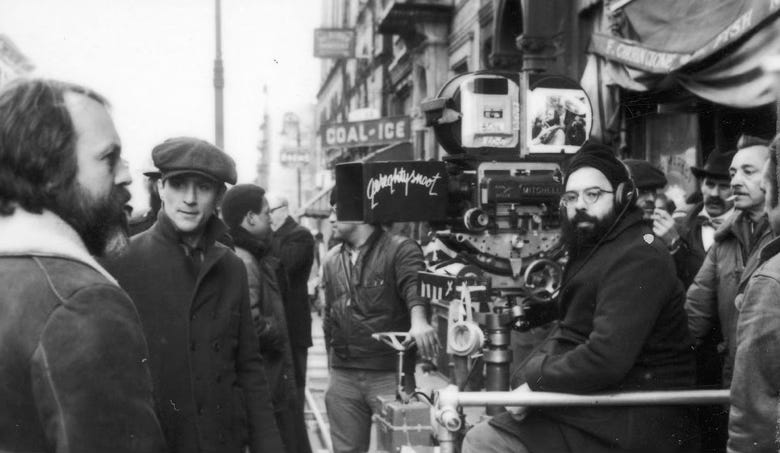
While I was at Hofstra, I learned that he was filming The Rain People nearby. I no longer remember exactly how I arranged it, but we ended up having breakfast at the Garden City Hotel. He was just as friendly as I remembered. He was genuinely interested in why I wanted to make films. Afterward, he introduced me to his assistant, George Lucas, a man in his early 20s. They showed me the bus they had converted into an equipment vehicle, carrying what they needed to make a feature with a small crew.
That bus made a powerful impression on me as did Coppola and Lucas.. A feature film could be made by people who packed their equipment into a vehicle and went to work. I could stand beside them, look inside, and imagine joining them. There was a possibility. at least in my mind, that I could become an apprentice on the production.
Little could I have imagined, forty years later, I’d be using an iPhone and a computer to do most of what they were doing, technically. But in 1967, they were making magic and I wanted in.
However, I knew that my parents would insist that I stay in school. They supported my ambitions, but they worried about how I would earn a living. I understood their concern, and I lacked the confidence to argue for a different choice. At eighteen, I wasn’t ready to trust my own judgment enough to leave the path laid out for me.
I have sometimes wondered what would have happened if I had gone. It is tempting to imagine that decision as a doorway to an entirely different life. Perhaps it was. But I know only the life that followed, and there was plenty in it I wouldn’t want to lose.
At Hofstra, much of my education took place beyond the classroom. I rode the Long Island Rail Road into Manhattan for jazz clubs and double features at the Thalia and New Yorker theaters. I discovered Cleopatra, my first Middle Eastern restaurant at 95th Street and Broadway, across from the Thalia. Movies, music, unfamiliar food—the city kept giving me reasons to come back. I reapplied to NYU.
After a year at Hofstra, I was accepted at NYU Film School. Ever since appearing on the Howdy Doody Show at six, I had wanted to live in Manhattan. Now I was there, living in Greenwich Village blocks from the Village Vanguard, studying film in the late 1960s. It was exhilarating. It was also exhausting.
My parents were dealing with challenges of their own, so I covered my $2,500 annual tuition with student loans and supported myself with part-time jobs. After my sophomore year, I started driving a taxi, eventually working nights and going to class during the day. Being young helped. Sleep would have helped more. Film school taught me filmmaking; driving a cab gave me an education in life.
One of my teachers at NYU Film School was Martin Scorsese. We called him Marty. He taught film appreciation and production, and his enthusiasm was contagious. His knowledge was extraordinary, but what I remember most is how eager he was to share it. He wanted to talk about movies, answer questions, and help us figure out how to make our own.
For his production class, I produced my senior project, Rough Ride, about one night in the life of a New York City taxi driver. I had found a subject through the job that was paying my bills. Marty praised the film. When you are young and uncertain about your abilities, encouragement from someone you respect can stay with you for decades.
Several years later, he directed Taxi Driver, a very different film about that world. I have always found the overlap memorable: the streets I drove for a living had also become the setting for my student film.
During our NYU years, Marty was building his own career and worked as an editor on Woodstock. We knew he was talented. We couldn’t have known the place he would eventually occupy in film history. The last time I spoke with him was outside the Sutton Theatre on East 57th Street, on the opening day of Mean Streets, on Sunday, October 14, 1973. The film had previously premiered to great acclaim a few days earlier at the 11th New York Film Festival, before beginning its regular commercial theatrical run at the Sutton. Marty was pacing and watching the crowd, visibly anxious about how the movie would be received. That is the image that has stayed with me: Marty outside a theater, waiting to discover whether an audience would connect with his work.
At NYU, I learned the practical elements of filmmaking, but writing became my strongest interest. My early screenplays also gave me plenty of reasons to question my abilities.
Then I discovered Ben Hecht. His work, especially his autobiography, A Child of the Century, made a lasting impression. Years later, I wrote a play about his Jewish activism. More recently, I returned to his story in a documentary about antisemitism in America, They Will Not Replace Us. A book I encountered as a young man had become part of my working life.
After graduation, I joined a small New York company making documentaries and industrial films. I learned from the job, but the routine soon wore on me. I quit—a hasty decision, in retrospect—to make a short documentary about saxophonist Frank Lowe, who had played with Alice Coltrane. The result was Street Music, released in 1973.
Somehow, it seemed appropriate that my first film after NYU was about jazz. Yet roughly thirty years passed before I returned to filmmaking and became the Jazz Video Guy in 2004.
Those years were full of other kinds of storytelling. As a jazz journalist, I wrote hundreds of articles, liner notes, and booklets, along with seven plays produced by a theater company I co-founded. Writing and theater occupied much of the space I had once expected filmmaking to fill.
When I returned to filmmaking in 2006 as the Jazz Video Guy on YouTube, I brought together two passions that had been with me since those early trips into Manhattan: film and jazz. I was finally making films about the music and musicians I loved. It had taken longer to find my way there than I’d imagined at seventeen.
And then there was Mel Brooks. Around the time I made Street Music, I rented a tiny guest room in a house on Fire Island with friends. One Sunday evening, on the train back to New York, I spotted him sitting alone. I asked whether I could sit beside him. He said the seat was available, but he wasn’t. He had work to do.
I had been laughing at Mel Brooks since my teenage years: the 2000 Year Old Man routines with Carl Reiner, his television appearances, his wonderfully uninhibited comedy. Like Lenny Bruce and George Carlin, he seemed willing to say things other people wouldn’t.
I couldn’t quite leave him alone. “Mr. Brooks, I’m a filmmaker, and I really enjoyed The Producers and The Twelve Chairs. Are you working on a new movie?”
That opened the floodgates. For nearly ninety minutes, he performed scenes from a script he had written: Blazing Saddles.
He became the characters, delivered the dialogue, and supplied the timing. I was helpless with laughter. Other passengers stared at us. There I was, on a commuter train, getting a private performance of Blazing Saddles before it became Blazing Saddles.
We also talked about movies, including one of his favorites, The Cabinet of Dr. Caligari. His knowledge reached well beyond comedy. When we arrived in Manhattan, we shared a cab downtown to the Village. So much for having no time to talk.
More than half a century has passed. I still remember Coppola showing me the equipment bus, Marty watching the crowd outside the Sutton, and Mel Brooks turning a train ride into a performance. Each encounter brought filmmaking closer. I saw the encouragement, uncertainty, enthusiasm, and effort behind the movies I admired.
At seventeen, I wanted to become a feature-film screenwriter and director. The career I imagined never quite happened. Instead, I wrote, made documentary films, helped create a theater company, and found my way back to jazz.
Now I live in Guanajuato, Mexico, and creating with new tools. I still have many stories to tell, in new and dynamic ways. Unlike some of my South Florida mishpucha, I don’t have a green leisure suit, white shoes nor do I line up for the four o’clock dinner special.
Maybe I’ll make it into my nineties. Maybe just until next Wednesday. Either way, I have work to do. Lots of it.
Next Tuesday: He Never Lost His Mask. He Was Buried Wearing One.
Blue Demon, a Luchador is the one I think about for Lucha Libre. Alejandro Muñoz Moreno, born 1922, García, Nuevo León. Started wrestling in the late forties, put on the blue mask in 1948. Held the NWA welterweight title and the middleweight after it. Trained constantly, they say. Wouldn’t break character in public. Never lost the mask in the ring, retired with it on, and supposedly went into the ground wearing one. You can decide what that means. I’ve quit deciding.
A life well lived…so far!