

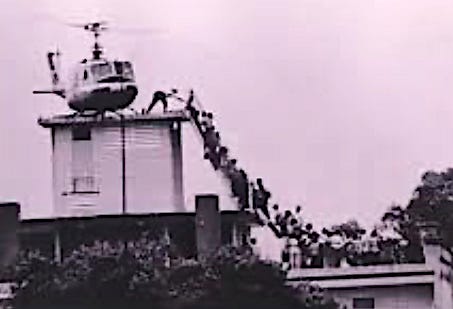
We have been here before. Not metaphorically, not historically at a comfortable remove. We have stood in this exact place, smelling this exact smoke, and watched this exact tragedy unfold, and learned absolutely nothing.
Fifty-eight thousand, two hundred and eighty Americans died in Vietnam. Let that number sit for a moment. Not a statistic. Fifty-eight thousand, two hundred and eighty human beings, most of them young enough to still be figuring out who they were. They died in a jungle war that the architects of American policy knew, from nearly the beginning, could not be won. The Pentagon Papers proved it. The tapes proved it. History confirmed it in every conceivable way. And when it was over, when the helicopters lifted off the embassy roof in Saigon and the whole catastrophic lie was exposed for the world to see, what did we say to the families?
We said: they died for their country.
Which is the thing you say when you cannot say the truth, which is: they died for nothing, because the men who sent them there were wrong, or cowardly, or both, and not one of those men ever spent a night in prison for it.
Approximately 2 to 4 million Vietnamese civilians and combatants were killed during the Vietnam War (1955–1975). Hundreds of thousands to over 1 million civilians were likely seriously injured or permanently disabled. The Vietnamese government has reported over 1 million war invalids. Landmines and unexploded ordnance continued to cause injuries after 1975. These post-war incidents pushed the number of maimed civilians higher over time.
Now we are doing it again.
On February 28, 2026, the United States and Israel launched surprise airstrikes on multiple sites across Iran, killing Supreme Leader Ali Khamenei and numerous other officials, even as nuclear negotiations were underway.  The administration claimed Iran had restarted its nuclear program, but a Pentagon source told Congress in closed-door briefings that there was no intelligence suggesting Iran was planning to attack US forces first.  In other words: a familiar story, dressed in new clothes. We have seen this film. We know how it ends.
The opening strikes unleashed a torrent of hundreds of retaliatory missiles and thousands of drones across the region. More than 2,000 people are dead in Iran, Lebanon, and Israel. Hundreds of thousands have been driven from their homes. The war is now in day 26, and it shows no sign of exhaustion.
Energy infrastructure is burning across the Persian Gulf. Brent crude has blown past $115 a barrel. Israeli strikes provoked Iranian retaliation against the region’s most critical energy arteries, and the damage runs deep. Qatar has reported what it called “extensive damage” at Ras Laffan, its main energy hub, the beating heart of global LNG supply. Analysts are warning that the world may be staring down a lasting gas shortage, not a temporary disruption, but a structural wound to the global energy system.
And the worst may still be coming.
And somewhere, right now, in Ohio or Georgia or New Mexico or California, there is a family that has not yet gotten the phone call. They do not know yet that their son or daughter, their husband or wife, their brother or sister, is gone. They are eating dinner or watching television or putting a child to bed. They are living in the last ordinary minutes before the knock on the door that will divide their lives into before and after.
What will we say to them?
We will say: they died for their country.
Because that is what we always say. Because the truth, which is that they died because a man who avoided military service in his own youth decided, from the comfort of the Oval Office, that this was the moment, is too terrible and too enraging to speak aloud in polite company. Analysts have noted that the assumption Iran would simply capitulate proved catastrophically wrong, and that Iran, perceiving itself in an existential fight, has no interest in a quick off-ramp, calculating instead that it is more willing to absorb casualties than either the United States or the Gulf countries. 
So the war will grind on. The families will keep multiplying. And the men who started it will move on to the next crisis, the next provocation, the next justification.
Here is the question I cannot stop asking. It is not a rhetorical question. I am asking it as someone who has spent sixty years in jazz, which is the music of human resilience and improvisation and survival, and who has therefore never stopped believing that human beings are capable of something better than what they keep demonstrating: Is it genuinely beyond our species to stop this? Is the violence so deep in us, so structural, so profitable for so many powerful people, that we are constitutionally incapable of choosing otherwise?
Technology is not going to save us. We are producing artificial intelligence and hypersonic missiles simultaneously, which is the definition of a civilization that has its priorities exactly backwards. We are closer to extinction, not farther from it, and the people making the decisions are the least likely to acknowledge that. Economists are warning of a potential worldwide recession, with global food prices already rising and energy markets in crisis, and we are twenty six days into this war with no clear exit strategy in sight. 
John Coltrane understood something about this. He understood that the only meaningful response to a world bent on its own destruction was to keep playing, to keep insisting on beauty and complexity and spiritual depth in the face of everything. “A Love Supreme” was not an escape from the ugliness of the world. It was an argument against it.
I don’t know what argument we so desperately need right now. But I know we need one. And I know it has to be something more, something far more, than what we are currently offering the families of the dead.
A folded flag. A single word: hero.
That is what we have. That is all we have. And it is not enough. It has never been enough. The mothers know it. The children who will grow up without a parent know it. The widows sitting in silence at kitchen tables know it.
We owe them more than a triangle of fabric and a word we use to avoid saying what we actually mean, which is: we sent them, and now they are gone, and we are still arguing about why.
The least we owe them is the truth about what we sent them into.
Perhaps the word is Love. Coltrane was searching for the Love Supreme, the note beyond the scales beyond the beats. The God particle. The notion of the search or even stability for humanity has been lost to the western world. The emergence of a new world order must come forth and say stop. It will not come from the U.S. and Europe. The world is facing an existential crisis with potential for previously unknown destruction.
"Is the violence so deep in us, so structural, so profitable for so many powerful people, that we are constitutionally incapable of choosing otherwise?"
Bret, this is a good question and I would say the violence IS in a percentage of us that have low self esteem (due to poverty, racism, reliance on destructive religions, dystopic families). I think the rise of nationalism, hateful treatment toward immigrants, and overall violence are all due to this pain and the pervasive feeling of worthlessness and despair. Violence fills that awful void in these people. But the majority are not inherently violent, so it is up to the majority to keep the violence at bay in any society.
The problem right now is that the hateful and the violent have gotten the upper hand due to society shocks since the 2008 financial collapse and millions of Americans lost their homes and jobs due to elite rapaciousness. We have beaten back the violence before and we will do it again by continually showing up to the fight. Tomorrow - show up!