

As we age, the cast of characters changes. We lose our friends, our loved ones, our cultural icons. And eventually, we join them. The closer we get to the end, the pace quickens. Coming from America, where death is feared, living in Mexico has taught me an entirely new perspective. I’m grateful.
The first time I attended a Mexican wake, I didn’t know what to do with the laughter.
It was four years ago, a neighbor of a friend, someone I had never met. I went because Sherrie thought we should, because that’s what people do here. The body was in the front room. Children ran through the house. Someone had brought a guitar. By midnight the stories had grown louder and more specific — this man’s stubbornness, his appetites, the time he drove his truck into a ditch and blamed the road — and I sat there holding a small glass of tequila thinking: in America we would have all gone home by now.
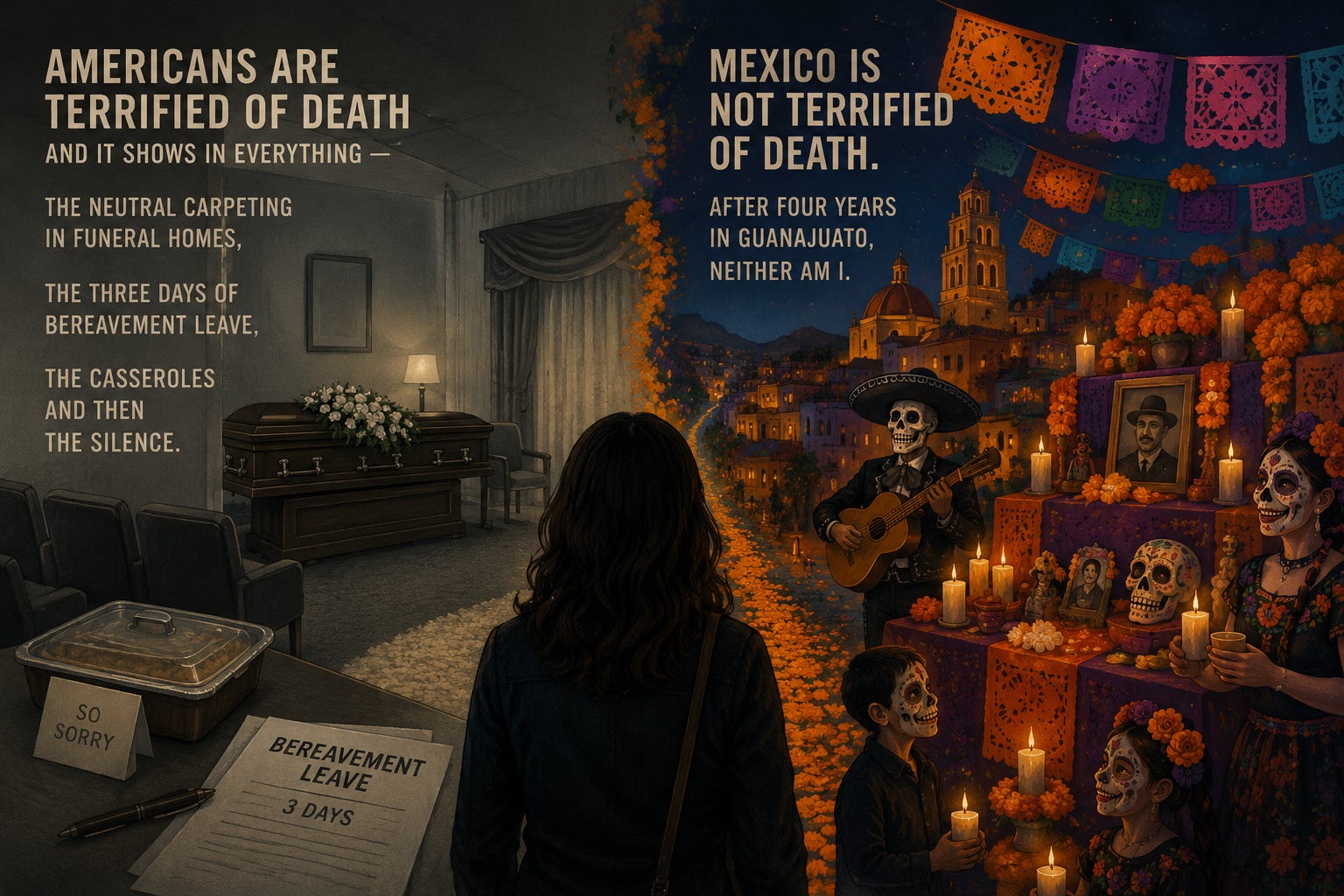
I grew up with the other kind of death. The neutral carpeting. The three days of bereavement leave. The casseroles from neighbors, and then the silence, and then the unspoken expectation that you will compose yourself and return, because grief held past a certain point begins to feel, in American professional culture, like a character flaw. I lost people over the decades and I processed them the way I was taught — quickly, privately, with the urgency of someone who has a schedule to maintain. The country corrected me the way reality always does — slowly and without apology.
Mexico does not process the dead. It keeps them.
When someone dies, people gather in homes. The stories get louder as the night continues. Music enters the room. Children stay present rather than being quarantined from mortality as though exposure might damage them. The dead person becomes socially alive again through recollection — and crucially, the recollection is honest. Their flaws survive. Their humor survives. Their appetites survive. Nobody transforms the deceased into a flawless motivational poster, which is both more truthful and more loving than the sanitized eulogies American funeral culture tends to produce.
The cemeteries here are built into neighborhoods, not exiled to suburban edges the way Americans situate things they find threatening. People speak of deceased relatives with startling immediacy, as though the relationship continued rather than concluded. During Día de los Muertos, entire cities stop pretending that memory is pathology. Grief is not the opposite of love here. It is one of its expressions, and it does not resolve on a schedule convenient for anyone.
Mexico laughs at death constantly. Skeletons dance during festivals. Cartoon skulls grin from every surface. Death appears familiar, a neighbor you have known long enough to stop fearing. When something has been integrated into ordinary life rather than sealed behind institutional walls, it loses its power to terrorize.
I have lost people I loved. I am 76 years old and the list is long now, and some of those losses I carried badly — sealed off, managed, filed. Four years in Guanajuato did not teach me to stop grieving them. It taught me that grief is not a problem requiring a solution. It is the price of love. It is worth paying.
The dead here still have addresses. They still receive visitors. Families clean the graves and bring flowers and tequila and music and eat nearby and tell stories that keep the dead present rather than filing them away.
They get a seat at the table.
After that first wake, I walked home through the callejones at two in the morning, the city quiet around me, and I felt something I hadn’t expected. Not sadness. Not the particular American dread that death tends to trigger. Something closer to relief.
This is the shape of things. You can live inside it.
Listening
In 1973, while record shopping, I discovered Rudolph Johnson's The Second Coming. on a new label, Black Jazz Records, out of LA. The guy behind the counter caught me reading the liner notes and dropped the needle without a word. Half a century later, Rudolph Johnson — a tenor saxophone master who spent years on the road with the Ray Charles Big Band — still stops me cold. One of the key spiritual jazz recordings of the 1970s, the album puts Johnson's Coltrane-influenced tenor at the center of a group that moves fluidly between post-bop, soul jazz, and the transcendent. Pianist Kirk Lightsey anchors it all. Listen and you'll hear why.
Watching
My criterion for memorable film is simple: am I still thinking about it a week later?
A woman fed up with her deadbeat kids boards a Greyhound to Montana and reclaims herself with the help of a Native American community. Clark Johnson directs with a light hand. The film knows exactly what it has: Alfre Woodard. She carries every frame. Her fourth-wall monologues alone deserved an Academy Award nomination. They didn’t get one. Juanita is not a complicated film. It doesn’t need to be. Woodard makes it necessary. It’s on Netflix.
Next Chick Corea
Next week I’m going deep on Chick Corea. I caught him just before Miles, followed him everywhere after that. There’s a reason he never stopped surprising people — the night he shared the Fillmore East stage with Keith Jarrett, two piano giants rewriting the rules in real time, I understood something about what Miles had passed on to him. Surprise wasn’t a trick. It was a discipline.
“Grief is not the opposite of love here. It is one of its expressions, and it does not resolve on a schedule convenient for anyone.” What a gift México gives the bereaved. Time and peace to feel. Thank you for your piece Bret.
Yes, I too appreciate the Mexican way of death! Nice descriptions, as always...