

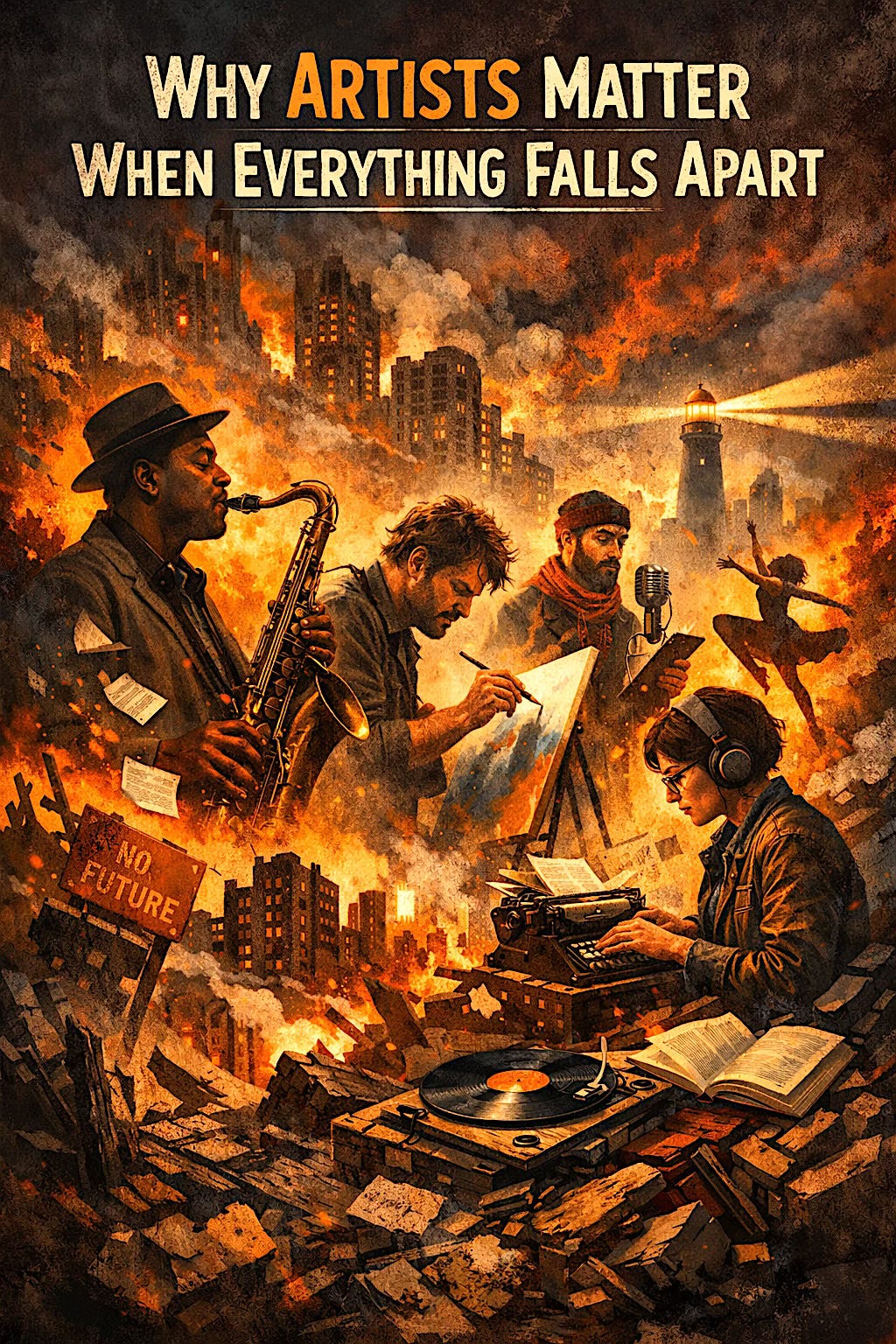
The room shakes. The amps hum. The drummer counts off while the building burns across the street. Systems snap. Banks wheeze. Institutions collapse mid-chorus. You feel the floor move because the tune changed and nobody told you.
Chaos scares people who want certainty. Artists live inside broken time. They grew up listening to Monk hit wrong notes on purpose. They know dissonance carries information. They know pressure cooks sound into heat.
Matter flips states under stress. Ice sweats. Water screams into vapor. No smooth fade. Only rupture. Society swings the same way. History never promised stability. Rome thought the gig would last forever. Feudal order faded. Factories rose. Digital noise blew the doors off. Every era swore permanence. Every era missed the exit sign.
Artists hear the change early. They catch the new tempo during the count-in. Baldwin heard it. Hesse heard it. They knew nothing stays fixed. The artist stands where two eras clash and lets the friction speak.
Right now sits square in the middle of breakdown. Old ideas about work, truth, authority, and meaning sound out of tune. New ideas warm up but haven’t arrived yet. Anxiety spreads because nothing resolves.
Artists feel this mess harder. No insulation. No mute button. Reality hits full volume. Many pay for it with sleep, money, sanity. Yet this raw exposure gives them the job. They turn noise into signal. They build form without lying about the chaos.
Watch John Coltrane in 1964, three years before he dies. He’s searching for something he can’t name. The quartet plays “A Love Supreme” and he’s pushing past melody into pure sound. Sheets of notes pouring out. His horn screams and prays simultaneously. He’s not playing pretty. He’s not offering comfort. He’s taking every contradiction he feels about God, race, violence, love, and forcing it through the instrument until it becomes coherent. Not resolved. Coherent. The suffering stays in the music but it has shape now. People can hold it. That’s the work. Absorbing chaos and making it bearable without making it false.
The process hurts. Artists do not simplify. They stack layers. They swallow the whole city. Then they practice. They revise. They shape the mess into something that holds when everything else slips.
Before the last world war, Hesse watched newspapers manufacture rage. The crowd bought the lie and marched. History answered with fire. After the smoke cleared, creation rushed in. Painters spoke in abstraction because realism couldn’t hold what they’d seen. Poets ditched rules. Rights movements tore at old chains. Medicine pushed death back. New music rose from rubble. Always does.
Art lasts because it stands on its own feet. Power needs scaffolding. Art does not. Kings rot. Bach still sings. Empires fade. Shakespeare still hits. City-states vanish. Sappho whispers across centuries with half a page.
Power hates this. Art clarifies. Tyrants prefer blur. Art teaches people how to listen. That scares anyone selling noise. Influence from art moves slow and deep. No leash. No off switch.
Artists drift outside the parade by default. They need distance to hear clean. From the curb, they spot cracks others step over. They save what the rush discards. They archive the human pulse.
This moment needs them. You need people who hold complexity without flattening it. You need forms strong enough to carry disorder. You need meaning earned through attention, not slogans.
No romance here. The work grinds. Money stays thin. Doubt stalks every session. Many die unknown. They keep going anyway because making equals survival.
Faith lives inside the act. Faith says human attention matters. Faith says suffering transforms when shaped with care. Faith says the work of bearing witness and making form preserves something human when everything else breaks.
Artists absorb the chaos, bend it into form, and leave behind a record of what mattered. Not comfort. Not answers. Just proof that consciousness can create meaning even when the world falls apart.
Note: This post was inspired by a post from the blog, The Marginalian, “A Lighthouse for Dark Times.” Richard Dubin sent me the link.
Spot on and diagnostic.
Explains my condition.
I've absorbed the chaos
So now I'm nauseous.
Thank you for your attention to this matter 👀
I love Hermann Hesse. Especially Demain because of the character named Sinclair. Glass bead game is good too because Joe Henderson loved that book. I read that one twice. Nicole glover say…. Glass bead game… that’s a long book. Check out my friend Aretha Tillotson’s new album “kinda out west” feat. Ingrid and Christine Jensen!