

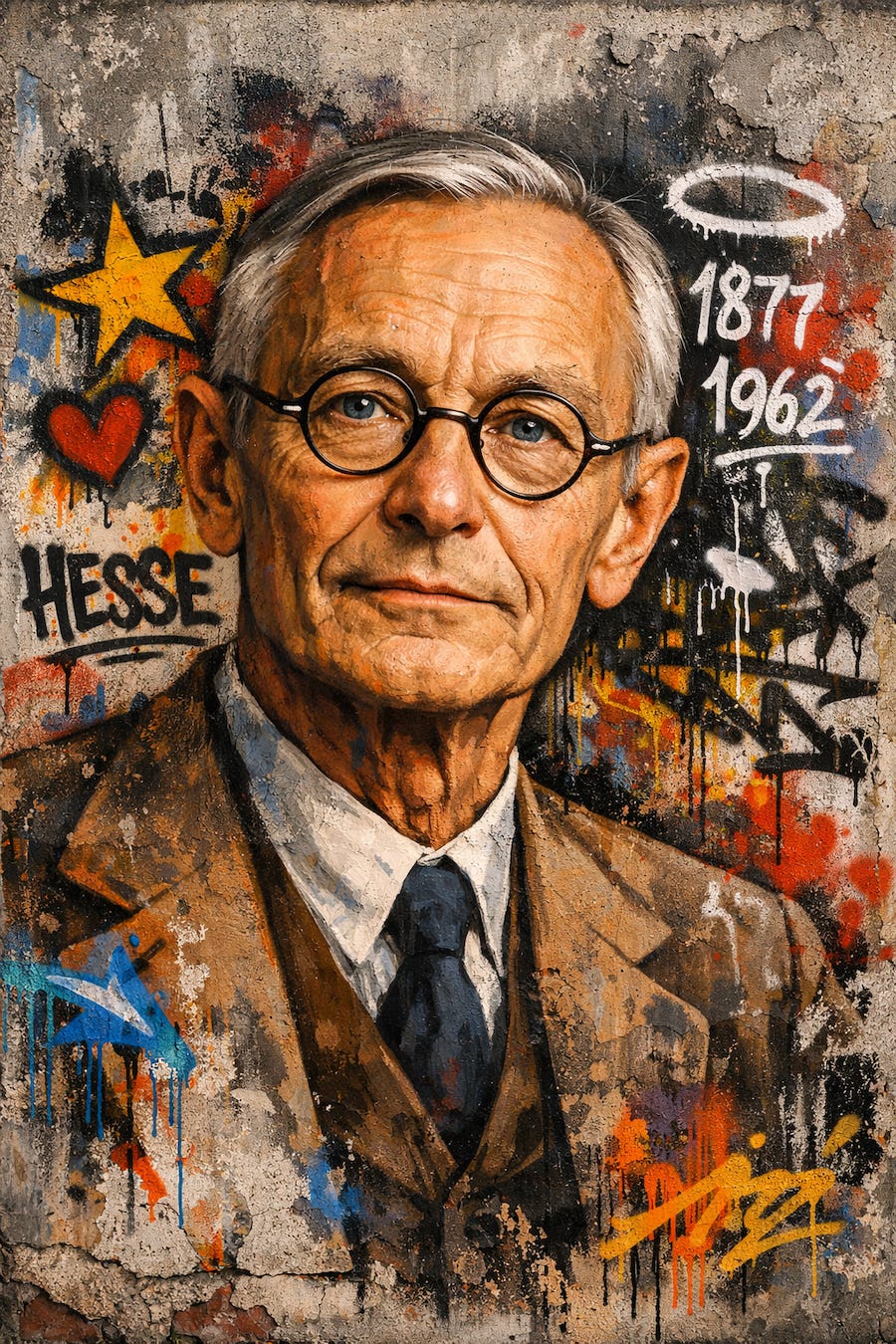
I went back into the old books. Not casually. Not for nostalgia. More like digging through a locked cabinet you swore you emptied years ago. Two volumes still humming with a low, dangerous voltage. Siddhartha and Steppenwolf.
I had not touched them since the 60s, which was a decade that chewed up identities and spit out fragments. You tried on masks the way people now try on apps. Some of them stuck. Most of them fused to your face before you noticed.
Hesse saw the problem early. Not suffering. Not death. Fraud. A deep, bone-level fraud. You walk into the world and someone hands you a personality like a rental car. Expectations. Roles. Scripts. You drive it for decades. Never check the engine. Never ask whose vehicle this is.
And one day you wake up exhausted, not from work, but from impersonation.
Hesse does not comfort you. He does not pat your head and hand you a method. He hands you a bill. The cost of becoming yourself. Full price. No discount. Paid in time, confusion, bad decisions, and long stretches where nothing makes sense.
You want meaning. He says fine. Build it yourself. No shortcuts. No imports.
In Siddhartha, the man goes straight to the source. Sits with the Buddha. Gets the cleanest wisdom available on the market. And then walks away. Not rebellion. Recognition. You cannot outsource experience. Enlightenment is not a lecture you attend and take notes on. You have to get dirty. Years of it. Mistakes. Regret. Desire. All the things polite philosophy tries to disinfect.
The river shows up and refuses to explain anything. No instructions. No summary. It flows. That is the lesson. Time collapses. Past and future lose their grip. What looked like wasted years starts to look like required material. Every wrong turn gets folded back into the same current.
You do not fix your life. You listen to it until it stops sounding like noise.
Then you hit Steppenwolf and the temperature drops. No serenity here. This one comes at you like a cracked mirror. Harry Haller. Half civilized thinker. Half animal with teeth. He tries to solve the tension by killing one side. Standard move. Society rewards it. Clean identity. Marketable personality. Smooth edges.
Hesse calls it what it is. Mutilation.
You are not one thing. You are a crowd. Conflicting voices. High and low. Sacred and obscene. The mistake is not the contradiction. The mistake is trying to iron it flat so other people feel comfortable around you.
You do that long enough and you end up with a version of yourself that fits nicely on a business card and feels dead everywhere else.
Hesse would look at modern identity culture and laugh until something broke. Consistency as virtue. Brand as self. You trim off anything that does not align with the image. What remains is clean. Also hollow.
Meaning does not show up when you unify the story. It shows up when you learn to move between your contradictions without lying about them.
Then he takes the knife one step deeper. No built-in meaning. None. The universe is not handing out purpose like pamphlets. You want meaning. You make it.
Art is the move.
Not decoration. Not therapy. Transformation. You take the mess. The fear. The private disasters. You shape them into something with form. Music. Film. Words. You impose pattern on chaos and call it a life.
Hesse understood this at a level most philosophers avoid. The creative act and the spiritual act are the same operation. You are not expressing yourself. You are building something that did not exist before, using your own confusion as raw material.
There is no clean separation. No safe zone.
He gives you three tools. Simple. Brutal.
Think. Not cleverness. Honest attention to your own mind. Watch what runs through it when no one is looking.
Wait. Time does work you cannot rush. Push too hard and you fake a conclusion.
Fast. Need less. The more you depend on conditions, the easier you are to control.
Do these long enough and something shifts. You stop reacting to every external demand. You stop negotiating your identity for approval.
Freedom starts to look less like escape and more like sufficiency.
Then the final hit.
No one is coming.
No teacher. No system. No perfect book, including these two. They point. They do not carry you. Meaning is not delivered. It is generated. By you. From whatever life you have already lived, including the parts you wish you could erase.
Those years were not lost. They were the material.
Hesse knew this was a hard road. He took it anyway. What he left behind is not comfort. It is a mirror. You look into it and see the performance start to crack.
And somewhere under the noise, something else waiting to step forward.
Remembering Hesse!! My favorite book of his is "The Glass Bead Game"!!!!!!
Brilliant, Bret. Thank you.