

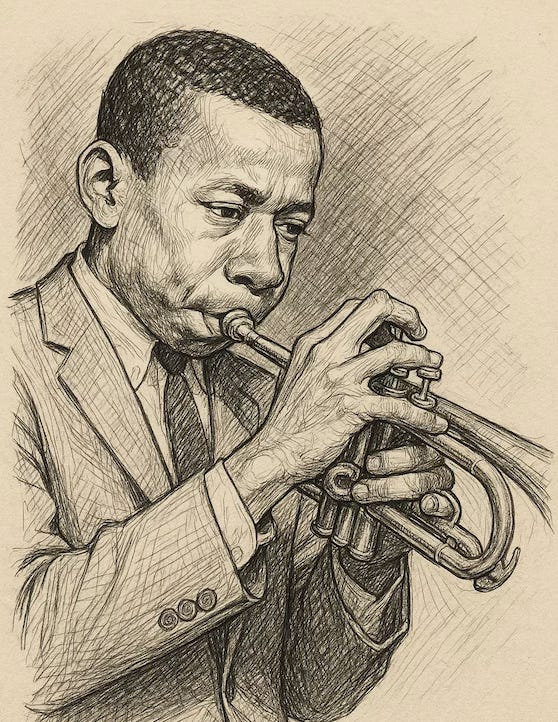
When Blue Note Records finally released Just Coolin’ in July 2020, jazz fans discovered a time capsule containing something extraordinary: Lee Morgan at age 20, already playing with the confidence, technical mastery, and emotional depth of a seasoned veteran. The album had sat in the vault for 61 years, but Morgan’s brilliance on these recordings remains undimmed by time.
The album was recorded on March 8, 1959 in Rudy Van Gelder’s living room studio in Hackensack, New Jersey. The lineup featured drummer Art Blakey, trumpeter Lee Morgan, tenor saxophonist Hank Mobley, pianist Bobby Timmons, and bassist Jymie Merritt. Five weeks later, Blue Note founder Alfred Lion decided to record the band again at Birdland in New York City on April 15, 1959, capturing a live recording that included four of the six titles from the March studio session. The Birdland sessions superseded the studio date when Lion released the two-volume live album Art Blakey & The Jazz Messengers At The Jazz Corner Of The World later that year. The studio version got shelved as redundant.
Three of the six tracks were written by Mobley: “Hipsippy Blues,” “M&M,” and “Just Coolin’.” The album also includes two previously unissued compositions: “Quick Trick” and “Jimerick.” This was a transitional lineup for the Messengers, coming right after the classic Moanin’ album with Benny Golson and just before Wayne Shorter joined the band.
By March 1959, Lee Morgan had already lived several lifetimes in jazz years. Born in Philadelphia on July 10, 1938, Morgan received his first trumpet as a thirteenth birthday gift from his sister Ernestine. His primary influence was the brilliant Clifford Brown, who gave the teenage Morgan a few lessons before Brown’s tragic death in a car accident in 1956. That same year, at just 18 years old, Morgan began recording for Blue Note Records.
Think about that for a moment. Most 18-year-olds are graduating high school or starting college. Morgan was already cutting albums for the most prestigious jazz label in the world, holding his own with established masters of the idiom. Within two years, he’d joined Dizzy Gillespie’s Big Band, where he remained for a year and a half until economic circumstances forced Gillespie to disband the unit in 1958.
When Morgan joined Art Blakey’s Jazz Messengers in 1958 at age 20, he wasn’t a sideman learning the ropes. He was a featured soloist, a composer, and a creative force who would help shape one of the most important bands in jazz history.
Listening to Just Coolin’ today, several elements of Morgan’s playing stand out immediately. His tone was remarkably mature for someone so young. Where many young players sound thin or tentative, Morgan’s trumpet voice was already full, warm, and authoritative. He possessed what musicians call “command of the horn”—that ineffable quality where technique becomes so internalized that the instrument feels like an extension of the player’s body and mind.
His technical facility was stunning. Morgan could execute rapid-fire bebop lines with pristine clarity, navigate complex chord changes with ease, and shift from aggressive, hard-driving passages to tender, lyrical moments without missing a beat. On tracks throughout Just Coolin’, like “Close Your Eyes,” you hear him building solos with architectural precision, starting with a simple melodic idea and developing it through variations, intensifications, and surprising harmonic detours.
But technique alone doesn’t make greatness. What separated Morgan from other technically proficient players was his emotional intelligence and rhythmic sophistication. He understood that space was just as important as notes, that silence could create tension and release as powerfully as sound. His phrasing swung with an ease that belied its complexity. He could play behind the beat, ahead of it, or right in the pocket, always serving the music’s emotional needs rather than showing off.
Art Blakey’s Jazz Messengers served as a graduate school for young jazz musicians, and Blakey himself was the ideal mentor for Morgan. Blakey understood that great jazz required both discipline and freedom, both tradition and innovation. He gave his young players room to stretch out, to take risks, to find their voices. But he also demanded excellence, pushed them to dig deeper, and created a rhythmic foundation so solid that musicians could build their most adventurous ideas upon it.
Morgan thrived in this environment. On Just Coolin’, you hear him responding to Blakey’s polyrhythmic complexity, engaging in musical conversation with Mobley’s tenor saxophone, and riding the groove that Timmons and Merritt laid down. This wasn’t a young player trying to prove himself. This was a mature artist contributing to a collective musical vision.
The transitional nature of this lineup makes the recording even more fascinating. Coming after the success of Moanin’with Benny Golson and before the more adventurous period with Wayne Shorter, this version of the Messengers captured a specific moment in the band’s evolution. Mobley, a charter member returning to the fold, brought his compositional skills and his warm, less aggressive tenor sound. The chemistry wasn’t as incendiary as some Messengers lineups, but it had its own appeal—a hip, streetwise swagger balanced with musical sophistication.
Reviews of Just Coolin’ note that while it may not reach the heights of Blakey’s most iconic albums, it’s still compelling music from legendary players in their prime, with Morgan and Timmons particularly on fire throughout. That “on fire” quality is what makes Morgan’s presence at age 20 so remarkable. He wasn’t just competent or promising. He was already operating at a level most musicians never reach in a lifetime.
Morgan would go on to even greater achievements. His 1963 composition “The Sidewinder” became a surprise crossover hit, bringing soul-jazz to a wider audience. He would record twenty five albums as a leader for Blue Note, contribute to countless sessions as a sideman, and help define the sound of 1960s jazz. Tragically, his life was cut short when he was shot and killed by his common-law wife at Slug’s saloon in 1972. He was only 33 years old.
But in March 1959, none of that future was written yet. There was just a 20-year-old kid from Philadelphia, standing in Rudy Van Gelder’s living room with his trumpet, creating music that would sit in a vault for six decades before finally revealing to the world just how great he already was. Just Coolin’ captures Lee Morgan at a moment when potential had already become achievement, when youth and mastery converged in a way that happens only once in a generation. Sixty-one years later, his trumpet still sings with that same fire, that same authority, that same ineffable magic that makes jazz matter.
Listen to eighteen-year-old Lee with Dizzy’s Big Band at Newport, 1957 “A Night In Tunisia”
Listen to Lee at twenty with Art Blakey, “Close Your Eyes”
Thank you for sharing Bret. I'm a huge Lee Morgan fan. Or was when I was deeply engaged in the music. It's always a treat when your writing brings back those memories.
Good stuff. One of the greats!