

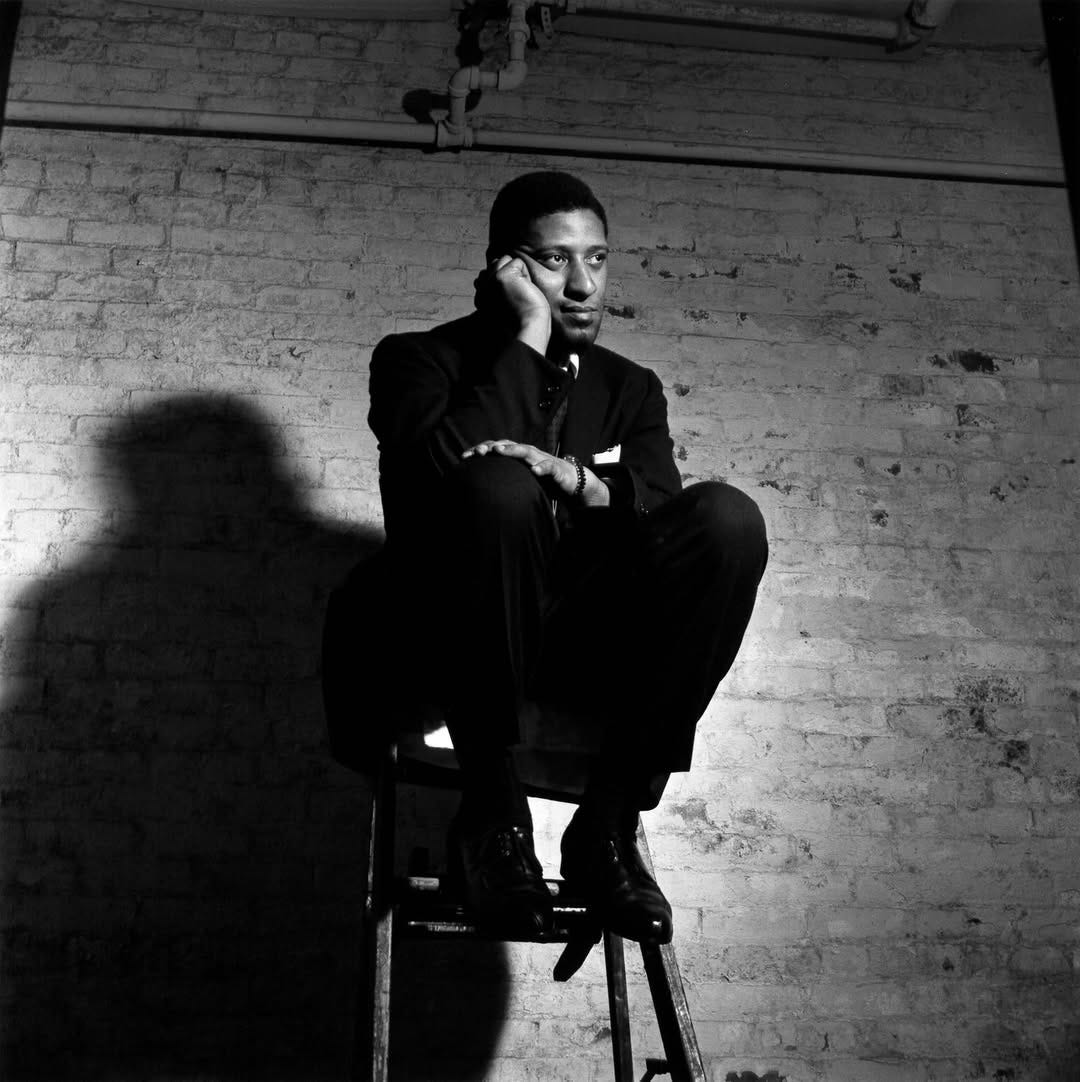
I wrote about my friend Sonny Rollins just after his passing, this May.
There will be a Celebration of Sonny’s music and life this Saturday in New York at an appropriate venue, the Cathedral of St. John the Divine. The Rollins family and the Jazz Foundation of America are producing the Celebration and asked me to put together a video. Here is the video that will be shown at the Celebration, taken from over a decade of interviews I did with the Saxophone Colossus:
I have known famous creators—filmmakers, musicians, playwrights and writers—whose work I admired long before meeting them. We want artists to embody their creations, but fame distorts, mythology fades, and the person behind the work is often painfully ordinary. Living among jazz musicians in New York taught me that a respected musician could make astonishing music and still be a difficult person. Both truths remain: the music does not absolve the person, and the person does not erase the music.
With Sonny Rollins, I stopped trying to separate them.
Sonny was a young man from Harlem who got addicted to heroin, like too many of his generation. He went through withdrawal and came out the other side. He survived when others didn’t. That’s worth noting. But it doesn’t make him special. It makes him lucky and stubborn. After that, he got to work and stayed at work. That’s what he did for more than sixty years.
In 1978, while writing for DownBeat, I was assigned a cover story on Sonny. I climbed the stairs to his house in Germantown. His living room was spare—a few pieces of furniture, nothing decorative. For a jazz star, he showed no interest in displaying what he’d earned. That told me something. He wasn’t interested in the image. He was interested in the work.
His cat jumped onto my lap. “He doesn’t usually do that,” Sonny said. I remember thinking that was a human thing to notice—a small moment between us, nothing more.
When I asked questions, Sonny went quiet. Three minutes. Four. He thought before he spoke. That wasn’t sacred. That was just his way. Each answer was considered. He didn’t waste words. Some people called it intensity. Some people called it difficulty. It was both.
Afterwards, he showed me his Woodshed in a small building behind the house. Books on the shelves—philosophy, history, essays. A saxophone on a stand. He had set up a room where he could work. Not decorated. Not precious. Just functional.
Over the next twenty-five years, we stayed in touch. Phone calls. Postcards from tours. I wrote more cover stories. We talked about music and politics and whatever was happening in the world. He read a lot—philosophy, political writing. He thought about things. That made him interesting to talk to. It didn’t make him enlightened.
What I was actually watching was a man who showed up and practiced. Every day. That’s not mystical. That’s just what he did.
Sonny had a reputation for being smart, opinionated, careful with words, and selective about who he spent time with. People said it came from spiritual seriousness. Maybe. Or maybe he just didn’t like small talk and didn’t pretend to. He held his positions and didn’t change them easily. That made him difficult. It also meant he knew what he believed.
But he also had another side. After gigs, if people were waiting outside, he stayed and signed autographs. He talked to fans. He made time. Not as performance. He just did it. His fans loved him and he returned it. That’s not contradiction at higher levels of consciousness. That’s just a guy who respected the people who cared about his work.
Sonny and Lucille were married for decades. She handled the business side—contracts, money, logistics. She freed him to focus on playing. She was a strong woman who thought differently than he did about politics and a lot of other things. They argued. Sometimes it looked like they were going to break apart. Then they’d be walking through an airport arm in arm. That’s not a spiritual teaching about holding contradictions. That’s just a marriage—complicated, real, holding together because they wanted it to.
When Lucille got sick and died in 2004, it changed him. Of course it did. She had been his center for decades.
After considerable discussion, I was hired to build a website for Sonny, which soon took me back into filmmaking. Digital video cameras were cheaper by then. Computer video editing arrived. Then YouTube showed up. By 2006, I was the Jazz Video Guy. I spent more time with Sonny. We did interviews. I stayed at his house in Woodstock. We became close. I witnessed first-hand what his commitment actually looked like.
On a concert day, Sonny would arrive at the venue around three in the afternoon for an eight o’clock show. He’d go to the dressing room and practice. Sound check at five. Back to the dressing room for two and a half more hours of practice. Then onstage for two and a half hours of playing. He could keep going, one idea splitting into three more ideas, for as long as the gig lasted.
This wasn’t about technique or perfection or transcendence. This was about work. He practiced because that’s how you stay sharp. He practiced because if you show up to play, you should be ready. He practiced because that’s what musicians do.
He was one of the greatest improvisers in jazz history. That’s just a fact. The improvisers I’ve known who take their work most seriously understand something simple: if you’re going to play, you owe it to yourself and your audience to be prepared. The music is the practice. Every time you play, you try to be better than last time. That’s all it is.
Then, in 2014, something broke.
Sonny kept an apartment in Lower Manhattan near the World Trade Center. On September 11, 2001, he went downstairs to see what was happening. The second tower collapsed while he was on the street. Concrete dust, chemicals, smoke, pulverized debris. He got evacuated the next day.
For thirteen years, nothing. He didn’t know.
Then his lungs started failing. He couldn’t make it through a concert. Gigs got canceled. Sonny told his doctor, over the phone he just couldn’t play anymore. I was there when he said it. There’s nothing to say in moments like that.
Pulmonary fibrosis. The poison from Ground Zero had waited thirteen years before presenting the bill.
Sonny had played the tenor saxophone nearly every day since he was twelve. Practice was his occupation, his daily routine, his meditation. The saxophone wasn’t separate from anything. It was just what he did. Sixty years of showing up and working. And then, suddenly, he couldn’t.
Without performances or recordings, there was less reason for me to be around. We stopped working together. He withdrew again. He had done that before—disappeared in the late 1950s and 1960s, vanished to figure things out, then came back. But this time was different. He couldn’t rebuild what he’d lost. There was no comeback from this.
I had asked him once about his greatest challenge. He said: “My greatest challenge every day is to try to wipe out some of the karma, wipe out some of the ignorant things I’ve done in my life—and I’ve done plenty of them. I’ve done some very cruel things in my life that I’m very ashamed of, but that’s all part of the learning experience of life. I’m still alive, so I have a chance to atone for them in some way.”
That’s honest. Most people, famous or ordinary, don’t admit that kind of thing. They certainly don’t sit with it. Sonny did. He knew he’d made mistakes. He knew he’d hurt people. And he kept working on being better. That’s not enlightenment. That’s just someone who decided to pay attention to how he’d treated people and try to do better. It takes work. Not everyone does it. Actually, few people actually do.
When the poison caught up with him and he couldn’t play anymore, something broke. I watched a man lose the thing that had organized his entire life. He didn’t get bitter about it publicly. He just withdrew. He kept working on himself, the same way he always had. Not as spiritual practice. Just as the work of being a person who had done damage and wanted to understand it and do better.
Sonny Rollins was an astonishing improviser and a fascinating man. He was loved around the world. But his real work was the simple one: show up, practice, try to be honest about who you are, try to do better than yesterday. It’s not special. It’s just what serious people do.
I came to know the work first. With Sonny, I was lucky to know the man too. And this man spent every day trying to get better at playing and trying to be someone worth knowing. When he couldn’t play anymore, he just kept doing the second part. That’s not transcendence. That’s just a guy being human about it.
He wasn’t perfect. He was stubborn and difficult and he could be harsh with people who disappointed him. He was also generous and he paid attention to the people around him. He read constantly and thought about things. He cared about his work and he didn’t pretend it was bigger than it was. It was just important to him.
That’s enough. That’s more than enough.
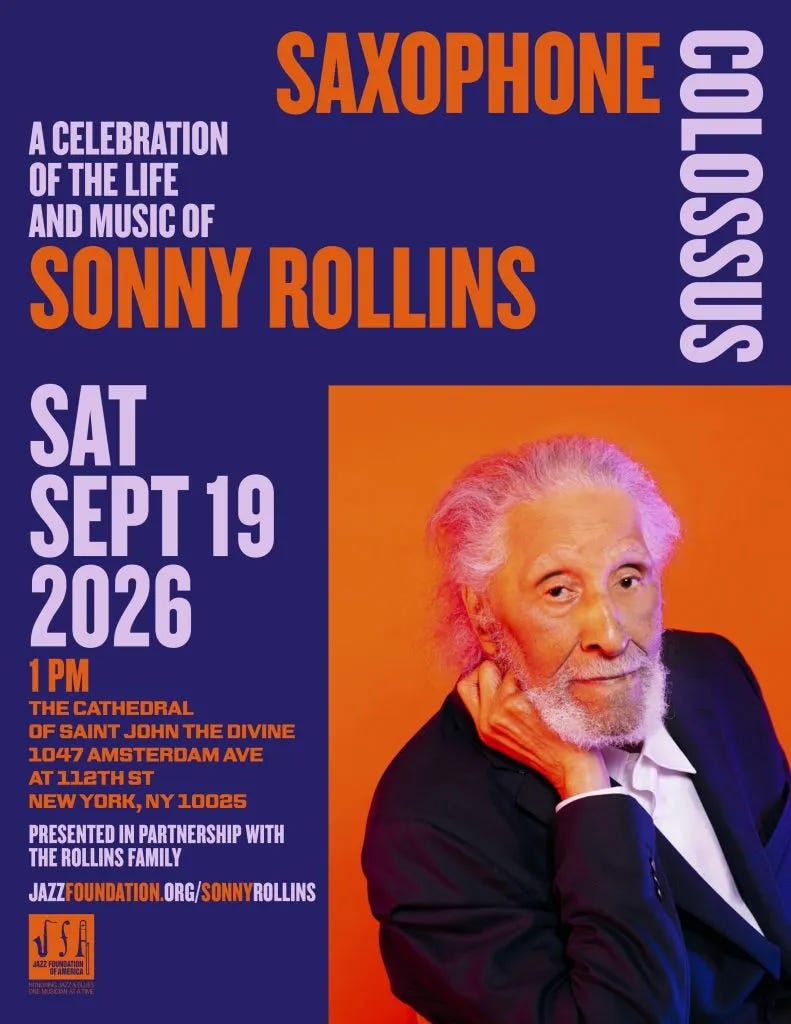
Next Tuesday: On the eve of the 100th anniversary of his birth, The Pursuit: How Coltrane's Demand for Perfection Shaped Modern Jazz.
]
Another wonderful piece, Bret. It provides much insight. Regrettably, I will not be able to attend the Celebration this Saturday. I will be performing in Cleveland. But, I will honor Sonny’s legacy by devoting myself to the music Sonny helped define.
He could always grab your attention and hold it for as long as he wanted. The consummate musical storyteller. Astonishing in depth and breadth of ideas he had. He played life. What more could you ask for? Thanks for bringing Sonny closer to us all these years Bret.