

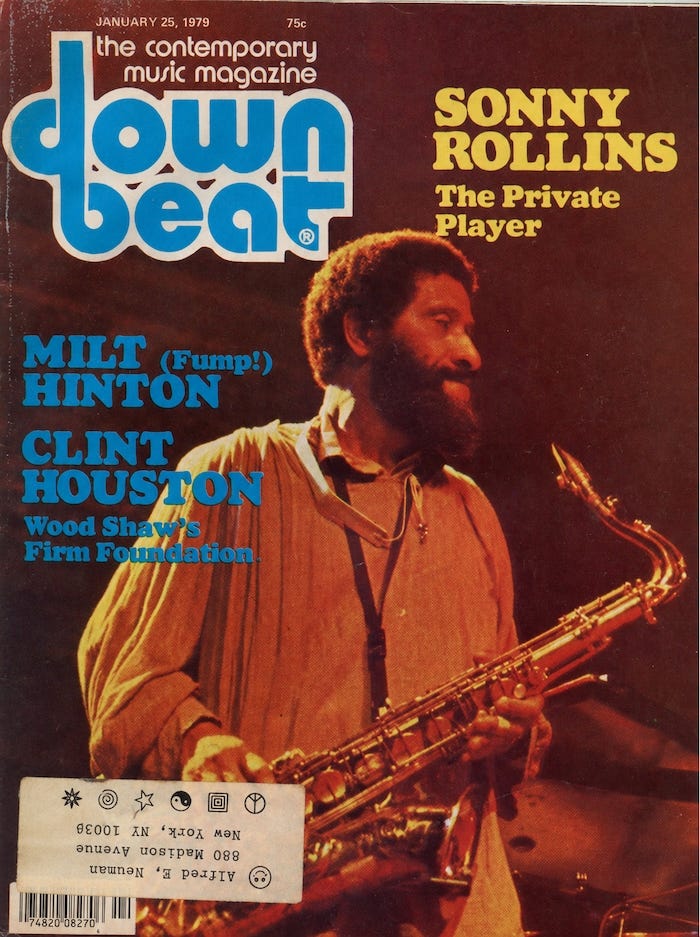
Sonny Rollins is gone. And with him, something in me closed.
I first met Sonny in 1978, when I interviewed him for a DownBeat cover story. He was already the Saxophone Colossus — I could feel it in the way he filled a room, the way silence gathered around him before he spoke. But what struck me then, and never left me across four decades of friendship, was that he carried his greatness lightly and his pain quietly.
He had survived the heroin epidemic that took so many of his generation. His closely knit West Indian family held him while his own fierce will drove him through cold turkey on Riker’s Island, and a few months at the federal narcotics hospital in Lexington, Kentucky. And from the moment he came back — rejoining Max Roach and Clifford Brown in one of the great small groups in jazz history — he never stopped. His life became one continuous improvisation: a musician pushing every boundary, a seeker chasing something beyond the notes, a spiritual being who found his practice in the act of playing, a survivor who turned damage into art. The celebrated sabbatical on the Williamsburg Bridge was just the most visible pause in a journey that never really stopped moving.
From 2004 to 2018 I produced his website and made lengthy interviews, performance, and documentary footage with him. I sat with him at his house in Woodstock, at the earlier one in Germantown, in his New York apartment, and on the road. We spent countless hours on the telephone. Sonny Rollins was unlike anyone I have known. Ferocious musical individuality. An unrelenting search for truth. And underneath all of it, traces of a young man from Harlem who had seen too much too soon and never fully stopped carrying it.
Contradiction held in one body. He was gentle and volcanic. Generous and immovable. A seeker who could also dig in like bedrock.
The generosity showed up everywhere, most visibly after gigs. It didn’t matter where in the world he was playing, what venue, what hour. If fans were waiting outside in the cold because the doors had closed, Sonny stayed. He signed autographs, talked, made each person feel seen. Not as an obligation. As a calling. His fans loved him with a loyalty that bordered on devotion, and he returned it in kind, one freezing sidewalk at a time.
Then there was the other side. Once, backstage at a Central Park concert, I brought Mark Kaplan — a friend since childhood, a fellow jazz obsessive — to meet him. Mark has a genuinely inexplicable gift: he can play music by striking his head with his fists, modulating the intensity of the blows and adjusting his breathing to produce actual melodies. That night he played the William Tell Overture. I watched Sonny’s face cycle through disbelief, helpless laughter, and something approaching philosophical crisis. I have never forgotten the look on his face.
But Sonny could be mercurial in his own quiet way, and if you found yourself on the wrong side of a Rollins conviction, you knew it.
Working with him on the website, I learned this early. He had no computer, no television, no interest in either. He understood the value of a web presence, but the mechanics of the internet were a foreign country he had no desire to visit. One Saturday morning he called me, upset. A friend had flagged something on the site: I had been rotating appreciations from fellow musicians about Sonny’s influence, and that week it was Joe Lovano. Somehow this had been read not as tribute but as intrusion — another musician on Sonny’s homepage. I explained, carefully, what it meant and why it was there. It was not an easy conversation. Once Sonny formed a view, dislodging it required patience, persistence, and the full knowledge that you might not succeed. He held his positions the way he held a note — for as long as he decided, not a moment less.
We didn’t always see eye to eye. But I never doubted him. He was a real friend and, in a unique twist of fate, also my generous employer. Sonny had the heart of someone who genuinely cared about the music, the people, and getting it right.
Jazz Video Guy began because of people like Sonny. It grew into 3,000 videos, 135,000 subscribers, 50 million views, and 20 years of documented history.
But Sonny’s death put a period at the end of that sentence. Not a question mark. Not a comma. A period.
I am not walking away from the music. Jazz doesn’t work that way, and neither do I. But I am done producing it. Done chasing interviews, building channels, maintaining archives. That chapter is complete.
What pulls me forward is something I have wanted to return to since I sat in Martin Scorsese’s classroom at NYU Film in the late 1960s: the making of visual fiction. Narrative. Story. Imagined lives that tell the truth. Sonny spent sixty years proving that the deepest truths don’t announce themselves — they have to be discovered in the act of making something. I learned that watching him and listening to him practice, backstage before gigs. Now I want to find out what it means in my own work.
The tools have changed. AI has handed me a new camera, and I intend to use it. Not as a shortcut. As an instrument — the way Sonny used everything available to him in service of what he was trying to say.
Jazz Video Guy built something real. Now it’s time to find out what else I can build.
Watch Sonny Rollins solo on “Tenor Madness” live in Japan, 1997.
Keep pursuing those muses, Bret. Profoundest condolences for your loss...
Brest wishes on your next chapter amigo.