

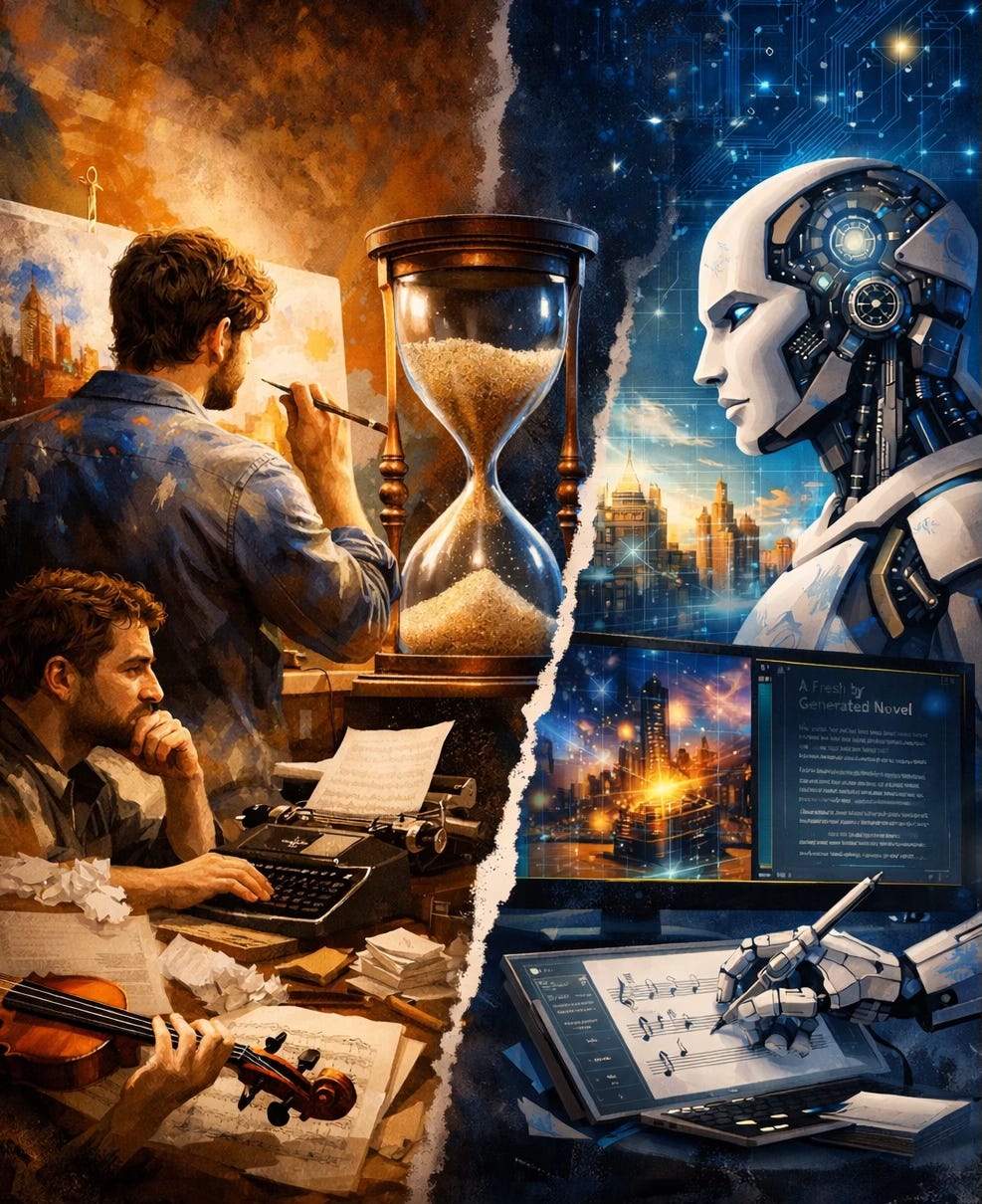
The question arrives at a peculiar moment. AI generates symphonies in seconds, paintings in milliseconds, novels during coffee breaks. The sheer speed and volume force us to confront something fundamental: what makes human creativity matter when machines can produce faster, cheaper, and often more polished outputs?
The answer isn’t found in defending old boundaries or pretending nothing has changed. Instead, it emerges from understanding what creativity actually means beyond mere production.
AI can generate, but generation isn’t creation in the human sense. This distinction goes deeper than semantics. When a human creates, they bring their entire existence to bear on the work. Every choice emerges from a web of experience, memory, and embodied knowledge that no pattern-matching system can replicate.
Consider how jazz musicians develop their sound. John Coltrane spent years developing his sheets of sound technique, practicing until his teeth hurt, searching for something he couldn’t quite name but knew he’d recognize when he found it. That journey lives in the music itself. A listener might not consciously identify it, but they feel the difference between notes chosen through struggle and notes assembled through probability.
Human creativity emerges from lived experience, from having skin in the game. When a jazz journalist writes about music after five decades of listening, interviewing musicians, and understanding cultural contexts, they aren’t just assembling information. They filter everything through a consciousness shaped by specific experiences: studying film under Scorsese, building websites when the internet was young, practicing Buddhism, learning Spanish at 76. That synthesis creates something pattern matching cannot achieve, no matter how sophisticated the algorithm.
The speed of AI generation actually highlights what makes human creativity distinct. A symphony created in seconds has no struggle behind it, no choices that cost something. The time investment in human creation isn’t inefficiency; it’s the process where meaning accumulates.
When someone spends seven months writing a book about Coltrane, returning to the project day after day, wrestling with structure and language, the duration itself becomes part of the work’s DNA. Each day brings new understanding, new connections, new doubts that must be resolved. The final product carries traces of that temporal investment in ways that transcend the mere arrangement of words.
Speed never defined creative value. Meaning did. The months spent learning an instrument, the years developing a visual style, the decades understanding a tradition: these investments create depth that instantaneous generation cannot simulate. Time becomes a kind of raw material, transformed through patience and persistence into something that resonates with others who understand that same human relationship with duration.
AI produces output without stakes. Humans create work tied to a body, a life, a limit. Our choices carry risk. Time costs us something. Failure leaves a mark. Those pressures shape judgment, restraint, and intention that audiences respond to, even when unspoken.
There’s no vulnerability in AI creation. A machine faces no risk in generating a novel that no one reads, a painting that moves no one, a song that falls flat. But when a person returns to book publishing after twenty years, knowing the landscape has transformed, that decision carries weight. The risk infuses the work with significance that pure generation cannot achieve.
Human work carries authorship in a deep sense. Not just a name attached to output, but the full weight of a particular consciousness making choices only that person could make. A symphony by a human reflects years of listening, loss, obsession, compromise, and discipline. Listeners hear struggle, patience, and taste. AI lacks biography. No hunger. No memory of silence before sound. No reason to care which note follows.
Human creativity matters because it’s fundamentally relational. When 130,000 people subscribe to a YouTube channel about jazz, they’re not just accessing information. They’re connecting with a particular consciousness, a specific enthusiasm, a unique path through the musical world. That human presence behind the work creates a different kind of engagement than any generated content can achieve.
Creativity mediates human experience. Art answers questions machines never face: How to live. How to age. How to grieve. How to love under constraint. Those answers change across cultures and eras, and humans track those shifts from the inside. We create to understand ourselves and to be understood by others who share our predicament of being conscious, mortal, and searching for meaning.
AI shifts the baseline without replacing the summit. It removes labor from some tasks, raises expectations for polish, and floods the world with content. But tools accelerate execution; they don’t supply purpose. In a world of infinite generation, human discernment grows more valuable. The ability to recognize what deserves attention, what feels honest, what connects to genuine experience becomes crucial.
Scarcity still matters, but it’s a different kind of scarcity now. Not scarcity of content but scarcity of attention, trust, and authentic connection. When output floods every channel, the human ability to curate, to contextualize, to say “this matters and here’s why” becomes more precious.
Your creativity matters because someone recognizes another mind reaching out. Not a system completing a task, but a person saying something true, flawed, and specific, once, from a place no one else occupies. That recognition, that moment of connection between two conscious beings through the medium of created work, remains irreducibly human.
The question isn’t whether AI can make things that look, sound, or read professionally. It can and will, increasingly so. The question is whether those things carry the weight of human experience, the risk of genuine choice, the vulnerability of someone putting their understanding of the world into form and offering it to others.
In the end, human creativity matters because we’re not just making things. We’re making meaning. And meaning emerges not from the speed of production or even the quality of output, but from the fact that a human being, with all their limitations and possibilities, chose to create this particular thing at this particular moment, investing their irreplaceable time in bringing something new into the world.
Great Article Bret!!! I would say this, you can't quantize Rhythm and Syncopation that comes natural in Jazz and really in Latin Music as well. I was Listening to a Christian Salsa Tune Last Year with My Cousin, and I Honestly could tell it was totally AI by the Compression of the Sound of the Vocals and The Conga Drums were totally Robotic. AI is Good For Somethings, but for Music? I Honestly Don't know about that except for Isolation Tracks AI Is Good, but for Songwriting? Not for me. Great Article Bret You Create An AI Coltrane, but it can't Replace the Real Trane
The music that I have heard from AI is simply inept in obvious and jumbled ways. Jumbled, as it sounds like arbitrary choices are made often regarding harmony, melodic ideas, stylistic consistency (or lack thereof). Most obvious is a robotic quality that in the end sounds bland and flat. Aside from its lack of humanity, it can't ever rival a Coltrane, Beethoven, or Mahler simply due to its aural incompetence.