

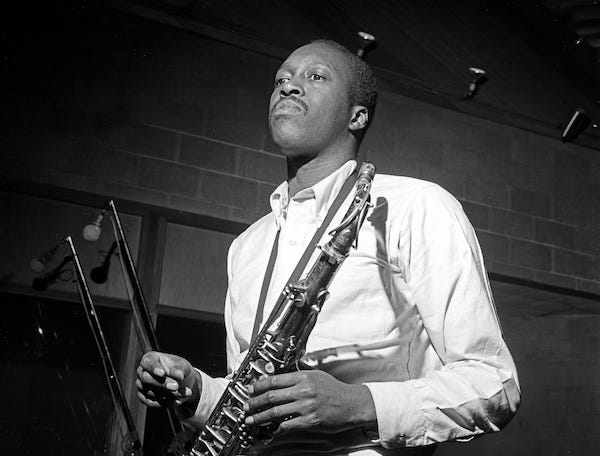
Hank Mobley earned deep respect among musicians and critics for several distinctive qualities that set him apart in the crowded tenor saxophone field of the 1950s and 60s.
Born in Eastman, Georgia in 1930 and raised in New Jersey, Mobley came up through the hard bop crucible of the early 1950s. He cut his teeth with Max Roach and Dizzy Gillespie before joining Art Blakey’s Jazz Messengers in 1954, where he became one of the group’s most important early tenor voices. That apprenticeship with Blakey taught him how to balance individual expression with collective swing, a lesson that served him throughout his career.
His sound was immediately recognizable - warm, round, and deeply soulful without being overtly emotional. Where some players went for power or edge, Mobley found a middle ground that felt genuine and unforced. That tone became his signature, something you could identify within a few notes. Critics sometimes underestimated him, calling him the “middleweight champion of the tenor saxophone,” but musicians knew better. That supposed middle ground was actually a carefully chosen aesthetic position.
What really distinguished him was his melodic intelligence. Mobley constructed solos that told a story, with careful attention to harmonic development and thematic variation. He wasn’t just running changes or showing off technical facility. Each solo had an internal logic, building ideas organically rather than stringing together flashy phrases. Musicians particularly appreciated this compositional approach to improvisation.
His relationship with Blue Note Records, beginning in the mid-1950s and extending through the 1960s, produced some of the most enduring music of the hard bop era. Alfred Lion and Francis Wolff at Blue Note recognized Mobley’s gifts early, making him one of their most frequently recorded artists. He appeared as leader or sideman on dozens of sessions, becoming part of the label’s core sound.
“Soul Station” from 1960 stands as perhaps his definitive statement - the title track and “This I Dig of You” feature Mobley at his most relaxed and inventive, weaving lines that breathe naturally while maintaining harmonic sophistication. His solo on “Remember” from that session demonstrates his gift for ballad playing, where his warm tone and patient phrasing created moments of genuine intimacy. The rhythm section of Wynton Kelly, Paul Chambers, and Art Blakey provided the perfect support, and Mobley responded with some of his most inspired playing.
“Workout” (1961) captured Mobley in a more energetic mood. His extended solo on the title track shows his ability to build tension and release over a longer form, never running out of ideas or falling back on clichés. The album also featured his blues mastery on “Uh Huh,” where his earthy, gospel-tinged phrases demonstrated his deep roots in African American musical traditions.
“No Room for Squares” (1963) found Mobley expanding his harmonic palette, with the title track showing how he could navigate more modern chord changes while maintaining his melodic clarity. His solo construction here reveals a player thinking several choruses ahead, developing motifs that paid off later in the improvisation. By this point, Mobley had fully matured as an artist, confident enough to take harmonic risks while staying true to his melodic instincts.
His contributions to various Jazz Messengers recordings, both with Blakey and in reunion settings, showed how he could deliver in high-energy settings without sacrificing his musical values. His tenure with Miles Davis in 1961-62, though brief and unrecorded in the studio, demonstrated the respect heavyweight players had for his abilities.
The “Dippin’” session from 1965 caught Mobley at a creative peak, with his playing on “The Dip” and “Recado Bossa Nova” showing his ability to adapt to different rhythmic feels while maintaining his core identity. His solo on “Recado” particularly demonstrated how he could swing over a bossa nova rhythm without forcing the issue. Lee Morgan and Harold Mabern joined him for what became one of his most accessible yet sophisticated recordings.
Musicians also treasured his work on more obscure sessions. “A Caddy for Daddy” (1965) and “The Turnaround” (1965) contain some of his most inventive playing, with solos that reward repeated listening as their subtle architectural brilliance becomes apparent. These later Blue Note dates showed Mobley continuing to evolve, never content to repeat himself.
Mobley wrote memorable tunes that became jazz standards. “This I Dig of You” remains a favorite for its singable melody and solid changes. “Funk in Deep Freeze” showed his ability to write heads that were both catchy and harmonically interesting. “Dig Dis” and “Soul Station” joined his book of compositions that other musicians loved to play. These tunes revealed the same melodic sensibility he brought to his playing - strong themes that gave soloists something to work with while standing up on their own merits.
His career trajectory took a difficult turn in the late 1960s. Personal struggles and the changing jazz landscape made work harder to find. He recorded less frequently, and by the early 1970s had largely disappeared from the scene. Drug problems contributed to his decline, though he made brief comeback attempts. He died in 1986 at age 55, largely forgotten by the broader jazz public though never by the musicians who had played with him.
What made Mobley special was his consistency across all those sessions. Whether leading his own date or supporting someone else, whether playing blues or complex post-bop changes, he brought the same integrity and musical intelligence. He never chased trends or tried to be someone else. In an era dominated by bigger personalities and more aggressive approaches, Mobley stayed true to his aesthetic vision and let the music speak for itself.
That authenticity, combined with his melodic gift and that gorgeous tone, created a body of work that continues to reward listeners decades later. Musicians still study his solos not for flashy licks but for lessons in how to build a meaningful improvisation from the ground up. The reevaluation of his contributions, which began in earnest in the 1980s and continues today, has restored him to his rightful place among the great tenor saxophonists of the hard bop era.
Watch rare footage of Hank Mobley in 1968 at the Jazzhus Montmartre in Copenhagen. It is from a Danish TV show called JazzBeat. Kenny Drew is on piano, Niels-Henning Ørsted Pedersen on bass, and Albert 'Tootie' Heath on drums. Thanks to Cory Weeds for finding this.
Thanks, Bret, for your writing about my all time favorite tenor player (ever since I in 1961 bought the album Meet You At The Jazz Corner Of The World with the Jazz Messengers). Hank Mobley's qualities as a composer can not be overrated, lots of hard bop and bluesy tunes not often played to day. Listen to Hipsippy Blues and Just Coolin'.
I've read at least 2 separate accounts. One was that Coltrane was in the building on another matter and Miles bumped into him and asked him to sit in. The other one is that Miles invited Coltrane to the session in advance. In any case, Coltrane had already left the group the year before.