

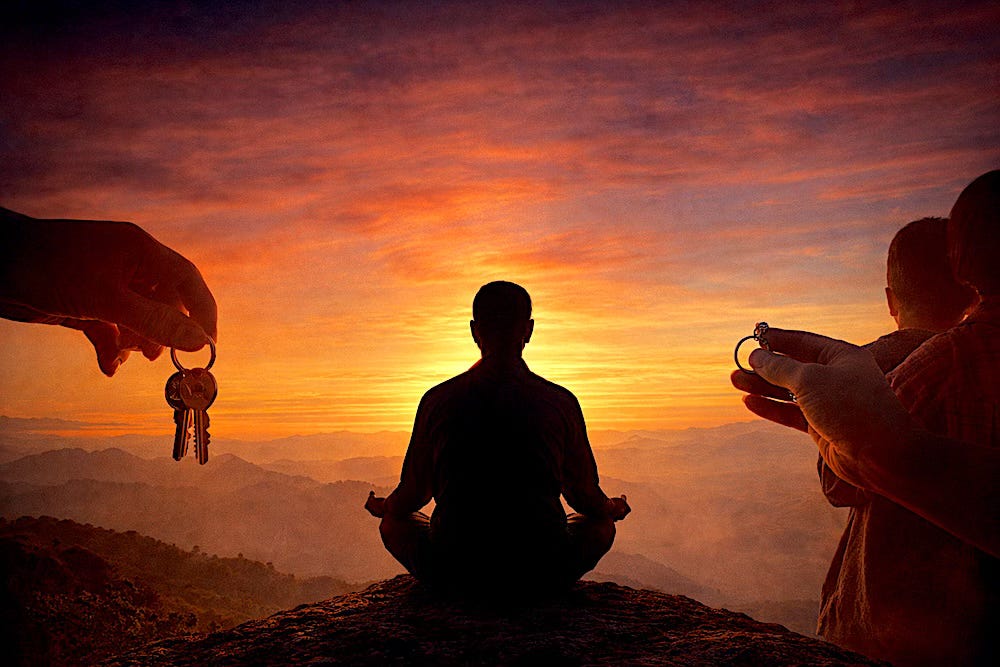
You already know that everything ends. You’ve known it since you were a child. And every once in a while, something breaks through the ordinary numbness -- a loss, a diagnosis, a quiet moment when the truth just lands. In that moment, a question rises: if everything ends, what actually matters?
This isn’t pessimism. It’s maybe the most honest question a human being can ask.
The Buddha started exactly here. Not with doctrine. With observation. He looked at aging, sickness, and death and refused to look away. He needed to know if there was anything that doesn’t fall apart. Anything that can’t be taken away. He found something. That’s what we’re going to look at.
Everything changes. The cells in your body are dying and being replaced right now. Nothing stays the same. In Buddhism there’s a word for this: Anicca, usually translated as impermanence. But that translation makes it sound abstract. It’s not. It’s the most concrete fact of existence.
Now, when this really lands -- not as an idea but as something felt -- the first response is often dread. If nothing lasts, why build anything? Why love anyone?
Sit with that for a moment.
Because here’s what a world without change would actually mean: your pain would never end. That grief you’re carrying -- no possibility of healing. That difficult situation -- no chance of resolution. Impermanence isn’t the enemy. It’s the condition of all possibility. It’s why music can exist, why stories can be told, why love can deepen. The suffering doesn’t come from change itself. It comes from our resistance to it.
At the level of everyday life, things genuinely matter. The Buddha spent an enormous amount of time teaching ordinary people -- householders, merchants, farmers, kings. People with families and jobs and responsibilities. He didn’t tell them that none of it matters. He told them how to live well. How to treat their parents. How to be a trustworthy friend. How to work honestly.
Kindness matters. Honesty matters. How you treat people matters. Actions shape who you become. Generosity, compassion, integrity -- these lead to tangible outcomes: trust, connection, a life you can look back on without regret.
And yet. Even the best life, lived with care and surrounded by love, remains subject to change. Which opens a question worth carrying: is there something that can’t be taken away?
There’s a pattern most of us recognize in ourselves. We try to arrange the conditions so that we can finally be happy. The right relationship, the right job, the right amount of money. When we get them, we feel good, for a while. When we lose them, we suffer.
The Buddha pointed to something more radical. Not tips for a better life. A deeper question: is there a happiness that doesn’t depend on conditions at all?
His answer came down to one word: tanha, usually translated as craving. It’s that quality in the mind that’s always reaching. Always wanting this moment to be different. Always grasping at what’s pleasant, pushing away what’s unpleasant. And the key insight is this: that craving doesn’t come from the objects we desire. It comes from within. It’s a pattern in the mind. Which means it can be seen, understood, and released.
The word most misunderstood in all of Buddhism: Nibbana. In popular imagination, some kind of spiritual paradise, a place you go. But the word literally means extinguishing -- a flame going out. What gets extinguished isn’t you, isn’t life, isn’t joy. What gets extinguished is the craving and aversion that keep the mind in constant agitation.
If your peace depends on having something -- a person, a possession, a feeling -- then your peace can always be disturbed. Nibbana is peace that doesn’t depend on having anything at all. Not because you’ve gone numb. Because the compulsion to grasp has fallen away. You can still enjoy things. You can still love. You can still engage fully with life. But you’re no longer imprisoned by the need for things to be a certain way.
The Buddha called it the highest happiness. Not because it feels more intense than other pleasures. Because it’s the only happiness that doesn’t come with a hidden expiration date.
None of this requires a monastery. The path the Buddha outlined -- training in how you see, how you intend, how you speak, how you act, how you work, how you direct your attention -- is walkable by anyone. A parent. A farmer. Someone sitting in an apartment in a city right now, reading this.
Even fifteen minutes of genuine attention each day can begin to shift patterns that have run unchecked for decades. You don’t need to be perfect to benefit. Every step brings something. Not just eventually. Now, in this life.
So: if everything ends, what actually matters?
Perhaps this. To love what’s here without demanding it stay forever. To care for what’s in front of you without losing yourself when it changes. To walk through this impermanent world with a heart that’s learning, slowly, to let go.
Not letting go of life. Letting go of the struggle against life.
Succinct and accessible presentation of the timeless Buddhist doctrine, nice!
Well, Bret, cheers on this post. It's always good to know there's another practitioner out here. Yes, this is the desire realm and no one knows that better than me. I have been chasing this or that for ages, but I am gradually slowing down. Daily practice helps, teachings help, like today's post. Appreciate the surprise.