

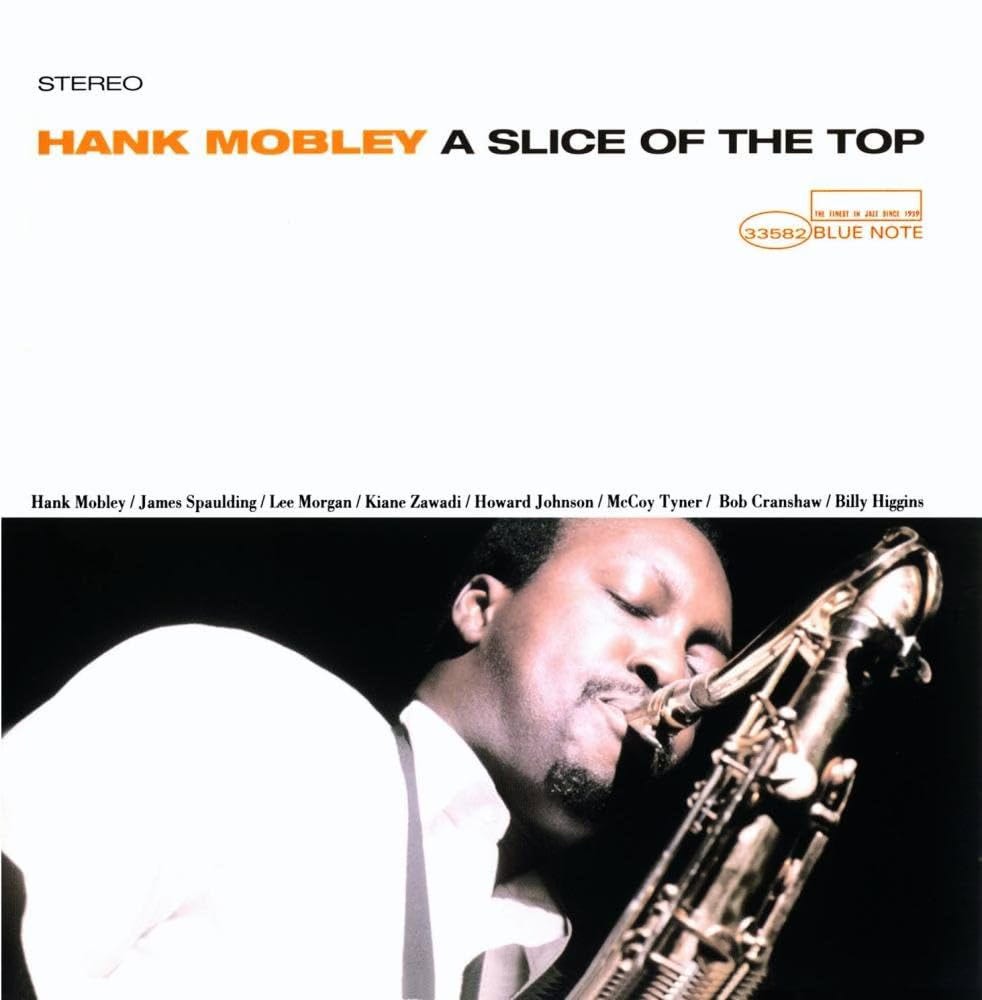
Hank Mobley’s decline stands as one of the most heartbreaking stories in jazz history. The man who once anchored some of the greatest hard bop sessions ever recorded spent his final decade battling illness, poverty, and the cruel indifference of an industry that had moved on without him. At the center of his tragedy lay a bitter irony: some of his finest work sat locked in Blue Note’s vaults while he struggled to survive.
The case of A Slice of the Top captures everything wrong with how the jazz industry treated Mobley. He recorded this ambitious session in March 1966 at Van Gelder Studio with an unusually large ensemble: trumpeter Lee Morgan, euphonium player Kiane Zawadi, tuba player Howard Johnson, alto saxophonist James Spaulding, pianist McCoy Tyner, bassist Bob Cranshaw, and drummer Billy Higgins. Duke Pearson provided arrangements that gave the music distinctive orchestral color.
The backstory makes the delayed release even more painful. Mobley composed the music in 1964 while serving time for a narcotics offense. He passed the sheet music to Pearson, who crafted the arrangements while Mobley remained behind bars. This was music born from confinement, written when Mobley had nothing but time to think about harmony and melody.
The recording session went well. The expanded instrumentation gave Mobley’s compositions a richer, more textured sound than his typical quintet dates. These weren’t just blowing vehicles but carefully constructed pieces that rewarded the orchestral treatment.
Then Blue Note simply sat on it. The tapes went into the vault alongside several other Mobley sessions from the same period. No explanation, no release date, just silence. The label didn’t release A Slice of the Top until 1979, thirteen years after it was recorded, three years after Mobley’s forced retirement, and seven years before his death.
The bitterness eventually consumed him. In a later interview, Mobley’s frustration poured out in words that have become infamous among jazz historians: “I have about five records on the shelf. Blue Note had half the black musicians around New York City, and now the records are just lying around. What they do is just hold it and wait for you to die.”
That statement cuts to the bone. Mobley understood exactly what was happening. The label that had built its reputation on his work was treating their catalog as inventory to be managed rather than art to be shared. The corporate owners who had taken over from Alfred Lion and Francis Wolff saw these recordings as assets to be released strategically, without regard for the artists who created them or needed the income and recognition they might provide.
Years of heavy smoking caught up with Mobley in the mid-1970s, attacking the very lungs that had powered his warm, rounded tone through countless Blue Note sessions. Lung cancer and emphysema made it increasingly difficult to play, robbing him of the one thing that had defined his life. By the time he was forced to retire, he was barely into his forties.
When A Slice of the Top finally appeared in 1979, Mobley was 48 years old, retired due to lung disease, and struggling with poverty in Philadelphia. The belated release brought no meaningful royalties, no career revival, no vindication. The jazz world had moved on. Critics gave it respectful but modest reviews, treating it as a historical curiosity rather than a major statement.
The original LP even contained an error that symbolized how little care Blue Note took with the release. The liner notes credited Reggie Workman as the bassist, when Bob Cranshaw had actually played on the session. If the label couldn’t get the basic personnel credits right after sitting on the tapes for thirteen years, what did that say about their commitment to the musicians?
Mobley fell into genuine poverty, experiencing periods of homelessness in Philadelphia. This was a musician who had recorded with Miles Davis, Art Blakey, and virtually every major figure in hard bop. He had created masterpieces for Blue Note throughout the 1960s. Yet there he was, struggling to find stable housing, dealing with addiction, living in circumstances that would have been unimaginable during his prime years.
What made his situation particularly bitter was the knowledge that much of his best work sat unreleased in Blue Note’s vaults. The label had shelved numerous sessions from his most creative period, recordings that might have sustained his reputation and provided royalty income. Instead, they gathered dust while Mobley struggled.
The delayed release of these sessions contributed directly to his declining fortunes. In jazz, visibility matters. Musicians who aren’t releasing records fade from memory, lose festival bookings, see their earning power diminish. Blue Note’s vault strategy may have made business sense to corporate accountants, but it helped push Mobley toward the homelessness and poverty that marked his final years.
The frustration ran deeper than just unreleased recordings. Fusion dominated the 1970s, and acoustic hard bop seemed hopelessly old-fashioned to many critics and listeners. Mobley, never a self-promoter, found himself marginalized and forgotten. The same critics who now praise his sophisticated harmonic sense and compositional brilliance had dismissed him during his lifetime as merely competent, a “journeyman” saxophonist overshadowed by Coltrane, Rollins, and Shorter.
The final years highlight the specific vulnerabilities of jazz musicians of that generation. Without the safety net of academic positions that later generations would enjoy, without the reissue royalties that came too late, musicians who fell ill or out of fashion faced genuine poverty. Mobley’s homelessness wasn’t just personal tragedy but systemic failure.
What makes his suffering particularly poignant is the contrast with his artistic personality. Mobley’s playing was unfailingly warm, generous, and optimistic in spirit. His solos unfolded with patient logic, building tension through harmonic sophistication rather than pyrotechnics. That same gentle approach may have contributed to his being overlooked, as critics mistook subtlety for simplicity.
There were brief flickers of hope. In late 1985 and early 1986, Mobley emerged for a few performances with pianist Duke Jordan at a small New York club. Witnesses reported that he could still play, that the essential Mobley sound remained intact despite everything. But these appearances were sporadic, limited by his deteriorating health. Audiences were sparse, and the moment passed without wider recognition.
The end came on May 30, 1986, in Philadelphia. Pneumonia finished what the lung cancer had started. Mobley was just 55 years old. The jazz press gave his death modest coverage. There was no outpouring of grief, no major tributes. He slipped away quietly, much as he had lived during those final years.
Mobley’s prediction proved tragically accurate. Blue Note did wait for him to die. When he passed away in 1986, the label suddenly discovered renewed interest in his catalog. Throughout the late 1980s and 1990s, they released the shelved sessions, reissued his classic albums, and marketed him as an underappreciated master. The music Mobley had begged them to release while he was alive became profitable once he was gone and couldn’t benefit from it.
The tragic irony is that Mobley’s reputation has soared since his death. Critics began reassessing his work with fresh ears. They discovered what musicians had known all along: that Mobley was a master composer whose tunes challenged improvisers in subtle, sophisticated ways. Scholars now place him among the essential figures in hard bop’s development.
But this posthumous recognition offers cold comfort. Mobley died believing he had been forgotten, unaware that future generations would treasure every note he recorded. He suffered through homelessness and illness without the knowledge that his music would endure, that the very recordings that sat unreleased in 1986 would become sought-after classics.
His story demands that we look beyond the music itself to the material conditions that allow artists to create and survive. Mobley gave jazz some of its most enduring compositions and performances. The music world gave him back loneliness, poverty, and premature death. That exchange seems fundamentally unjust, a stain on the industry’s conscience that no amount of posthumous praise can fully erase.
Listen to the title track, a Mobley composition, “A Slice of the Top.”
Bret, I remember one of those dates in Philly toward the end (1980s). Hank played a date at a club called The Upstairs on Broad Street. Pianist Sam Dockery played the gig with him. I couldn't get a ticket because the place was packed. So afterward I asked Sam how the gig went, and he told me Hank seemed tired and sat down a lot, but he was still on top of the music. Later, Mobley sat in at a jam session at Natalie's in town. The celebrated author/saxophonist James McBride (who wasn't celebrated at the time since his first book "The Color of Water" hadn't come out yet) was there writing an article on Philly jazz for the Philadelphia Inquirer. McBride totally trashed Mobley in print and when the story came out, the community ran the writer out of town. McBride ended up covering the Michael Jackson tour - the one where Jackson's hair caught on fire.
We should keep in mind that Alfred Lion and Francis Wolff ran a monumental label that documented so much for 30 years of this music. The label was sold in 1965 so really had no stewardship until George Butler in 1971/2 (until 1978/9), who had some success with crossover records from Donald Byrd, Earl Klugh and Bobbi Humphrey.and then Michael Cuscuna entered the picture basically as archiver and a producer in 1975 (the brown paper bag 2-fers and then this classic series and then of course the Capitol and Mosaic years). In that time from 1965 til at least the late 70's, the overall US music landscape had changed so much, especially for jazz, and Blue Note as a label had changed corporate hands a few times; Liberty, United Artists, Capitol, EMI, to eventually Universal. Lions did record more records than he could reasonably put out or market in his time and I'll admit some of the reasons for not releasing a session that were not business related, seemed odd in hindsight, but it was basically a 1-2 man shop for years and in those days, having even a minor hit (Sidewinder or Song For My Father) could put you out of business. In many ways, it's a miracle they survived as long as they did and certainly a miracle that they documented the amount of pivotal artists and musical movements that they did, giving them all brilliant artwork and full liner notes and of course the Rudy Van Gelder sound. Anyway, I say all this to add some context to Hank and several other musicians whose worked languished in the vaults for too long. Hank also had his own demons to battle, but I can understand his anger, There is a great interview with Hank that Billy Banks did when he was on WKCR in the late 70s/early 80's I believe, with The Musician's Show. Someone somewhere I'm sure has it. Hank was off the scene for so long that people were calling in asking Billy when the interview was done and Billy kept having to say, "Hank is still alive, he's right here!" Listeners couldn't believe he was still with us. Hank transitioned in '86.