

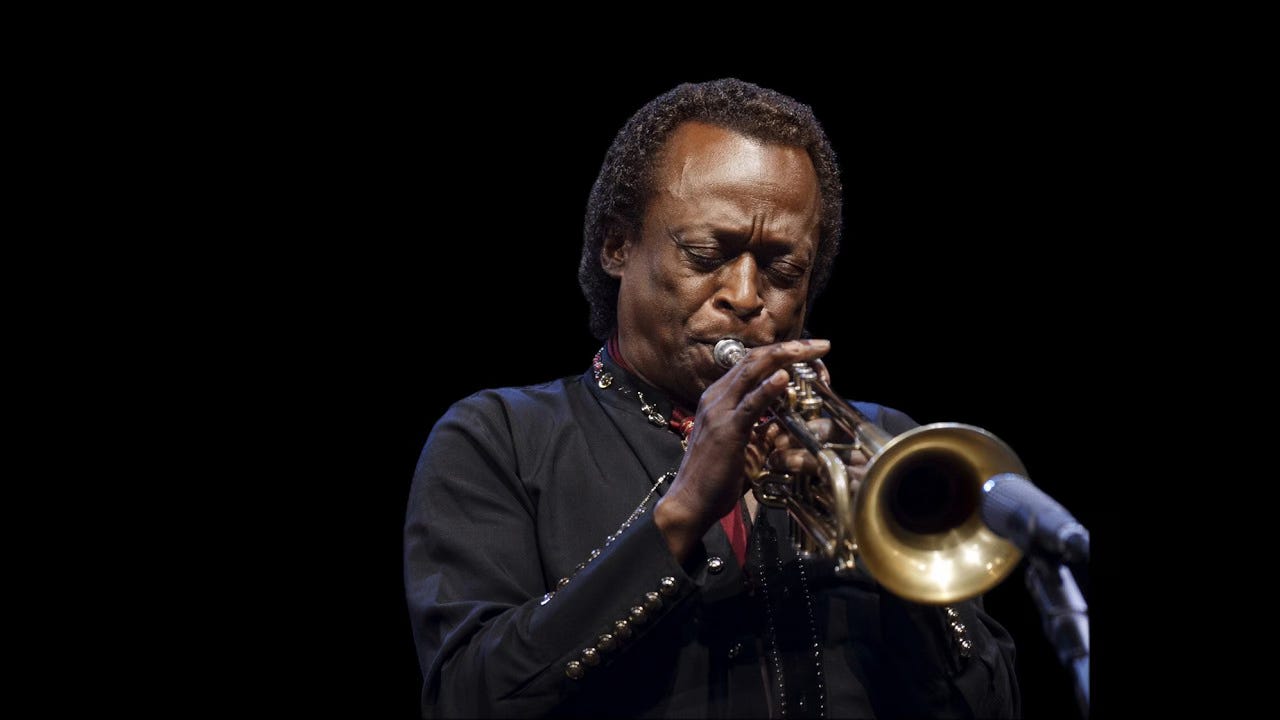
Miles Davis was born one hundred years ago on May 26. I've been listening to the Prince of Darkness non-stop lately. Some music rewards that kind of attention. His always has.
Miles Davis once said that if he stopped to think about what people wanted from him, he would be dead. He meant it professionally. He may have meant it literally. The history of his career is a series of rooms he walked out of before anyone else understood why, followed by years of argument about whether he had any right to leave.
He was punished every time. The punishment was real, specific, and delivered by people who had championed him. And he was right every time, which the same people eventually admitted, usually around the moment he was already three moves ahead of the admission.
Birth of the Cool, 1949 and 1950. Miles was twenty-three years old and had already played with Charlie Parker, which meant he had already been inside the fastest, most harmonically advanced music in the world. What he heard inside bebop that nobody else was hearing yet was the cost of all that velocity. The music had reached the outer edge of what speed and complexity could accomplish and was beginning to consume itself. What he did next was slow everything down. The nonet sessions he organized with Gil Evans and Gerry Mulligan produced something quiet, spare, and cerebral, arrangements that left space the way bebop never did. The hardcore bebop world considered it a retreat. Too white, too European, too polite. Miles had looked at the most revolutionary music of his generation and decided it needed to breathe. He was told he was going soft. He was twenty-three.
The first great quintet, 1955 to 1959. Coltrane on tenor, Red Garland on piano, Paul Chambers on bass, Philly Joe Jones on drums. The critical establishment loved this band while simultaneously worrying about Miles personally, the heroin years, the volatility, the famous rudeness to audiences. He turned his back to the crowd. He walked off when he was done playing and didn’t return for applause. The punishment here was social: Miles was brilliant but difficult, gifted but ungrateful, the kind of talent that made critics nervous because he refused to perform appreciation for an audience that felt it was owed some. He cleaned up, kicked the habit cold in his father’s house in East St. Louis, came back harder.
Kind of Blue, 1959. The most important jazz album ever recorded arrived as a rebuke to bebop’s harmonic complexity. Instead of chord changes cycling faster than most listeners could follow, Miles built the music on modes, vast open fields that gave the soloists room to find their own path rather than race through a predetermined obstacle course. It sounds, half a century later, inevitable and obvious. At the time it was a provocation. Some players found it too simple, too open, not enough architecture. The bebop purists who had already complained about Birth of the Cool now complained about this from the other direction. Miles had found a way to be criticized for both too much European refinement and too little harmonic sophistication. He released the album and moved on immediately.
The second great quintet, 1964 to 1968. Wayne Shorter, Herbie Hancock, Ron Carter, Tony Williams, a band so collectively intelligent that they could dismantle a standard and rebuild it in real time, playing what they called time, no changes, floating free of the harmonic structure while still somehow implying it. This was the most sophisticated music Miles ever made, and the punishment for it was a particular kind of critical bafflement. The audiences who wanted Kind of Blue found this quintet opaque. Miles was accused of abandoning melody. He was abandoning certainty, which is a different thing, but the distinction required listening carefully and critics who had already filed their Miles Davis takes were not always inclined to start over.
Bitches Brew, 1970. This is where the punishment became institutional. Miles plugged in. Electric keyboards, electric bass, wah-wah trumpet, rock rhythms layered in ways that produced a sound with no existing genre. Jazz critics who had spent careers defending him felt personally betrayed. Some refused to review the album. Others declared that Miles had sold out, that he was chasing the rock market, that the music was a commercial calculation. It was none of those things. It was Miles hearing something in Sly Stone and Jimi Hendrix and James Brown that jazz hadn’t figured out yet and deciding to be the one who figured it out. The album sold 400,000 copies in its first year, unheard of for anything adjacent to jazz. A new generation found it thrilling. The old guard never fully forgave him.
Then the body quit. By 1975 the hip problems and the sickle cell anemia and the accumulated damage of twenty-five years of relentless forward motion had ground him down. He retreated to his Manhattan brownstone and the trumpet went silent for five years.
What happened in that brownstone resists easy narration. He drew the blinds, took drugs, watched television, and waited for something to change. For a man constitutionally incapable of stillness, five years of enforced silence was its own kind of violence. The jazz world that had spent decades arguing about him found, in his absence, that it simply missed him. And Miles, who had always defined himself by motion, had to discover what remained when motion was taken away. Nothing in his history had prepared him for the answer.
He came back in 1981 to the most complicated reception of his career. His chops were diminished, his embouchure needed rebuilding, and the music world had moved through disco, punk, and new wave in his absence and was now generating something called hip-hop that Miles, characteristically, found more interesting than threatening. He pursued synthesizers, pop textures, electric everything, and covered Prince and Cyndi Lauper in concert. The old guard recoiled exactly on schedule. But the band had genuine fire and the music was doing what Miles’s music had always done, pulling toward something that didn’t have a name yet. The dismissals this time had a defensive quality, the sound of people who had learned nothing from the previous five times and knew it.
Miles Davis recorded nine studio albums in his last decade. He painted. He collaborated with hip-hop producers. He did not look back, which in his case was not nostalgia avoidance but something more like a physical inability to face that direction. He died in 1991.
By then Bitches Brew was canonical. Kind of Blue was canonical. The second great quintet was being studied in conservatories. Birth of the Cool had been recognized as the seed of an entire movement. Each act of punishment had been quietly commuted, each verdict reversed, each exodus from a room he’d been told he had no business leaving vindicated by the subsequent history of the music.
He was not gracious about any of it. He was not built for gracious. He was built for whatever was coming next, and the critics who wanted him to stay in one place were, in his view, not really listening to the music at all. They were listening to what the music used to be, which is a different instrument entirely, and one Miles Davis never learned to play.
Watch Miles play Time After Time from the North Sea Jazz Festival 1985, with John Scofield on guitar, Bob Berg on saxes, Robert Irving on keyhboards, Darryl Jones on bass, Vince Wilburn Jr. on drums, and Steve Thornton on percussion.
The man was humanly complicated, to be sure, but his instincts behind the horn were impeccable – & he proved an amazing mentor to so many younger talents along the way …
Wonderful piece with the exception of overlooking On The Corner.