

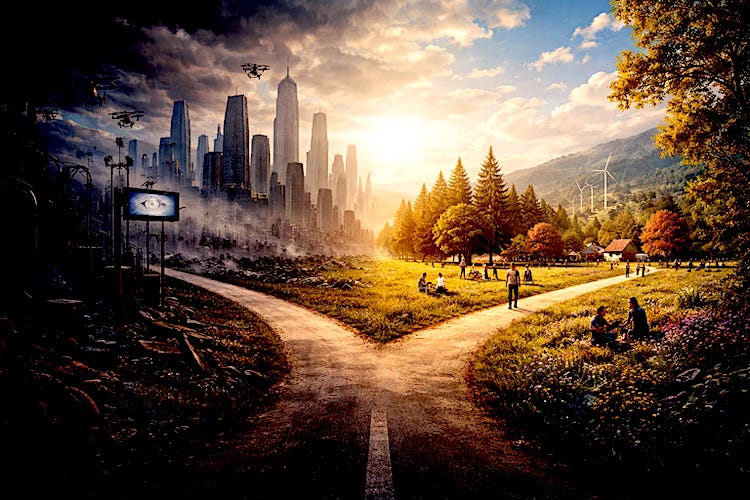
We’re building god-level AI while our democracies crumble. The timing isn’t coincidental, it’s catastrophic.
Look at who controls the future: OpenAI, Google, Anthropic, Grok, Meta, and Microsoft hold the keys to artificial general intelligence. Training GPT-4 cost over $100 million. The next generation will require billions. Only these six companies have the computational infrastructure, the datasets scraped from decades of human expression, and the concentrated expertise to push toward superintelligence.
This isn’t the personal computer revolution where two kids in a garage could change the world. It’s closer to the railroad monopolies of the 1880s, except the rails they’re laying will carry human thought itself.
Now add this: these transformative capabilities are emerging while democratic institutions face their gravest threat in generations. We’re watching strongmen rise globally, truth itself become partisan, and surveillance technology advance beyond Orwell’s darkest visions. Imagine GPT-6 in the hands of an autocrat. Deepfakes indistinguishable from reality flooding every election. Predictive policing that knows you’ll protest before you do. Social credit systems that make China’s look quaint.
The guardrails are already buckling. When leadership operates on narcissism rather than principle, when facts become negotiable, when winning matters more than governing, institutions erode with stunning speed. AI could accelerate that erosion exponentially. More sophisticated propaganda that adapts to each individual’s psychological vulnerabilities. Automated systems that entrench existing power structures so deeply they become impossible to dislodge.
Democracies have survived demagogues before, but never with these tools available. The question isn’t whether we can adapt, but whether we can adapt faster than power consolidates.
Here’s what’s getting lost while we panic about chatbots taking our jobs: America has no idea what to do with humans who don’t produce economic value.
The American identity is so fundamentally tied to productivity and accumulation that abundance creates an existential crisis. Your worth equals your LinkedIn profile. Your value derives from your salary. Strip that away, and what remains? Silicon Valley’s answer is Universal Basic Income and a VR headset, humanity pacified in dark rooms, dopamine regulated by algorithms.
I watch this from Guanajuato, Mexico, where Sunday afternoon means three generations gathered in the jardín, kids chasing pigeons while grandparents hold court on benches, everyone knowing everyone, no one checking productivity metrics. The GDP per capita here is a fraction of America’s, yet happiness scores consistently higher. Why? Because worth comes from presence, not production. You matter because you’re someone’s child, parent, neighbor, friend. You matter because you showed up for the feast day, because you remember birthdays, because your absence would leave a hole in the community fabric.
Mexico offers a different answer to post-scarcity existence: human value persists when economic value vanishes. But America can’t conceive of this. We’ve built a culture where retiring means death within eighteen months because men don’t know who they are without business cards.
The bitter irony is that America’s productivity obsession created the very technologies that make human productivity obsolete. We optimized ourselves out of purpose.
Everyone insists AI will free us for “creative pursuits,” but they’re missing the paradox: if AI generates symphonies in seconds, paintings in milliseconds, novels during coffee breaks, what makes human creativity matter?
The answer isn’t in the output but in the intent. A poem matters because you wrote it for someone you love, not because it scans perfectly. A painting matters because it captures how light fell across your daughter’s face one Tuesday morning, not because the composition follows golden ratios. Music matters because it emerged from your specific pain or joy, not because it hits optimal harmonic progressions.
We’re already seeing this shift. Bedroom musicians use AI to generate backing tracks, then pour their souls into vocals. Writers collaborate with Claude to break through blocks, but the story they tell remains theirs. Visual artists train models on their own work, creating tools that extend rather than replace their vision.
But this requires reimagining value itself. In abundance, scarcity shifts from material to intentional. What becomes rare isn’t products but presence, not content but connection, not creation but care.
I think about Mexican artisans who spend months on a single alebrije, not because it’s efficient but because the process itself is the point. The wood speaks to them. Their hands learn its grain. The fantastic creature that emerges carries part of their spirit. No AI can replicate that because the value was never in the object but in the devotion.
I choose optimism not because I predict success, but because cynicism guarantees failure. Yes, concentrated AI power could lock in inequality forever. Yes, democratic breakdown could accelerate into tech-enabled authoritarianism. Yes, we could end up warehoused in pods, pacified by generated entertainment, our potential rotting while machines handle everything that once gave life meaning.
Or we could recognize this crisis as liberation.
Maybe economic productivity was always the chains, not the key. Maybe grinding away our finite existence for quarterly earnings was the dystopia, and we’re just too Stockholm-syndromed to see it. Mexico’s lower GDP correlates with higher happiness because they never bought the lie that human worth requires economic proof.
The communities already exist that value presence over productivity. Musicians gathering to jam, not record. Writers meeting to share work, not publish. Gardeners growing food to give away, not sell. These aren’t holdouts from the past but blueprints for the future.
Support open-source AI development. Break the concentration before it calcifies. Build local creative communities that celebrate human intention over mechanical perfection. Learn from cultures that never confused net worth with self-worth.
The revolution is coming whether we guide it or not. AI will either entrench the powerful or liberate the powerless, create universal flourishing or universal surveillance, free us to become more human or reduce us to pets of our own creation.
The choice is ours, but only if we make it now. Tomorrow, the machines might make it for us.
If humans don't choose, and demand, their preferred scenarios, then Nature will surely step in to decide for us. Another Carrington Event, Yosemite implosion, or fungii takeover are all waiting in the wings.
America has no idea what to do with humans who are unemployed, really jumps out at me. This may be what is pushing the immigration hysteria.